
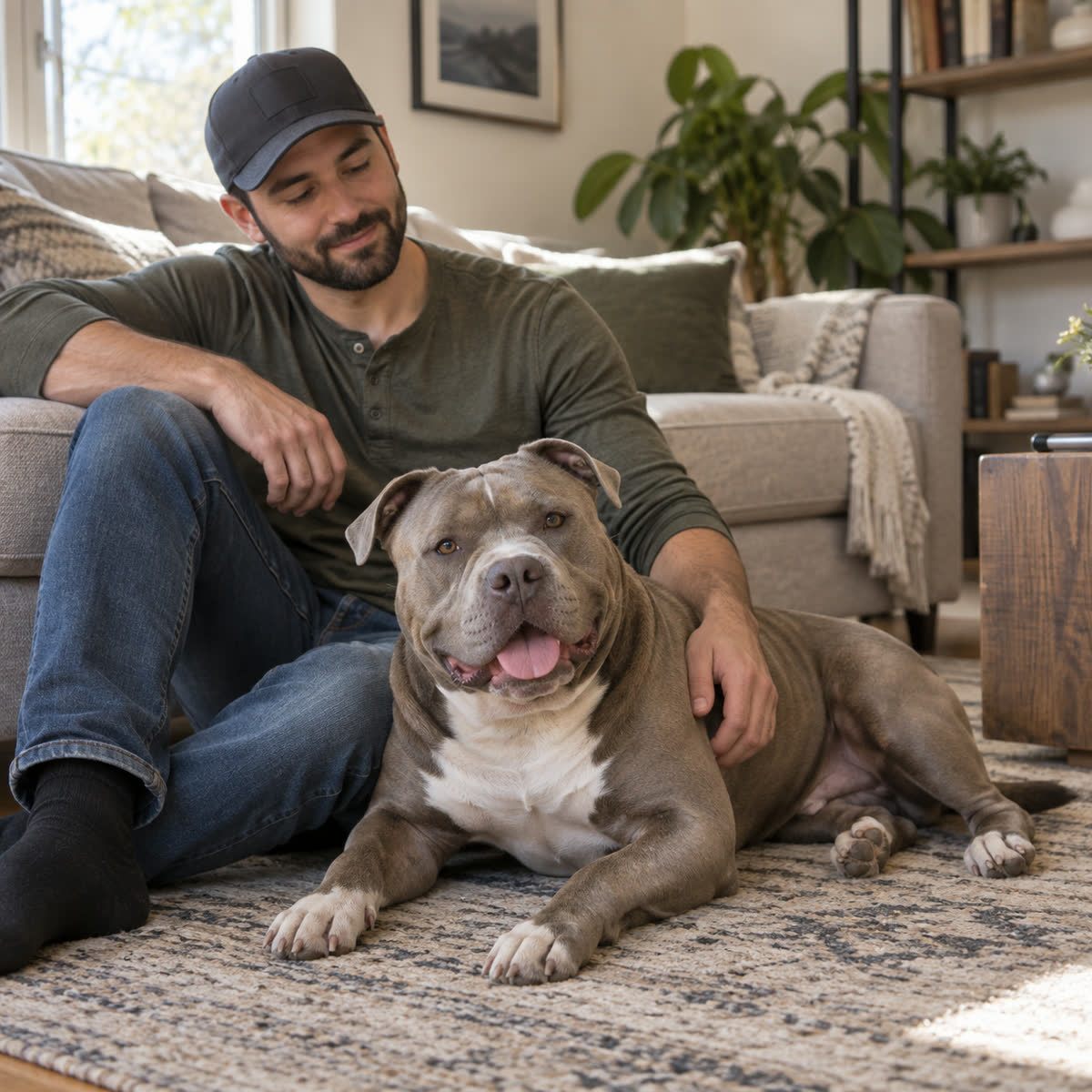
Yes, generally: American Bullies are bred to be gentle and friendly, and both major registries penalize aggression toward people in the written standard. But that’s a breeding goal, not a guarantee for any individual dog — how yours actually behaves with kids, other dogs, or a stranger at the door depends far more on its breeding, socialization, and supervision than on the breed label alone. The sections below cover what decides that outcome for a specific dog, whatever its American Bully type.
This article is educational and not a substitute for veterinary or professional dog-behavior advice. If your dog shows aggression toward people or other animals, consult a veterinarian or certified dog behavior professional.
What do the breed standards say about American Bully temperament?
The American Bully’s temperament is written directly into both major breed standards, not left to interpretation. The ABKC breed standard describes it as a companion breed exhibiting confidence, a zest for life, and an exuberant willingness to please and bond with family. The demeanor is gentle, and the standard states the breed is great with kids and extremely friendly with strangers, other dogs, and other animals. The ABKC goes further than a compliment: it lists “displaying or possessing aggressive behavior towards humans” as a disqualification, not just a fault. The UKC standard describes a companion breed with confidence and a zest for life, a gentle and friendly demeanor, and calls it an excellent family dog. Aggression toward humans is “uncharacteristic of the breed and highly undesirable,” and the standard disqualifies viciousness or extreme shyness.
The breed itself is young. Breeders began developing the American Bully in the 1980s, working largely from the American Pit Bull Terrier with American Bulldog, English Bulldog, and Olde English Bulldogge influence. The type was largely settled by the 1990s. The ABKC recognized it as a breed in 2004; the UKC followed on July 15, 2013.
Here’s how the two standards, and real-world experience, line up across the questions owners actually ask:
| Situation | What the ABKC/UKC standard says | What to expect in reality | What makes the difference |
|---|---|---|---|
| Kids | “Great with kids”; gentle demeanor | Usually affectionate, but size and strength (especially XL) can knock over a small child by accident | Supervision, breeding, early exposure to children |
| Other dogs | ABKC: “Friendly with other dogs”; dog aggression is highly undesirable | Dog-selectivity can still emerge as some individuals mature | Socialization window, neutering status, controlled introductions |
| Strangers | “Extremely friendly with strangers”; extreme shyness is highly undesirable (ABKC) / disqualifying (UKC) | Generally outgoing; not a natural guard dog; fear-based reactions come from poor socialization, not the standard | Confidence-building, exposure before 3 months |
| Cats / small pets | Not addressed directly by either standard | Varies by individual prey drive; some live peacefully with cats, some never should be left unsupervised with them | Early, gradual introduction; management, not assumption |
Does breed actually predict how your dog will behave?
Breed explains less of an individual dog’s behavior than most owners assume. A 2022 study in Science (Morrill et al., “Ancestry-inclusive dog genomics challenges popular breed stereotypes”) found that breed accounts for only about 9% of behavioral variation between individual dogs. Most behavioral traits, however, remain meaningfully heritable. A breed standard like the ABKC’s or UKC’s describes what breeders are selecting for — a target — not a trait every puppy is guaranteed to inherit. That’s exactly why the standards themselves single out temperament as a disqualifying fault when it goes wrong: they know individual dogs can fall outside the ideal. Two American Bully puppies from different breeders, or even the same litter, can land in noticeably different places on confidence, reactivity, and sociability. The reasons include genetics and — most controllably — the socialization they get in their first weeks.
Are American Bullies good with kids?
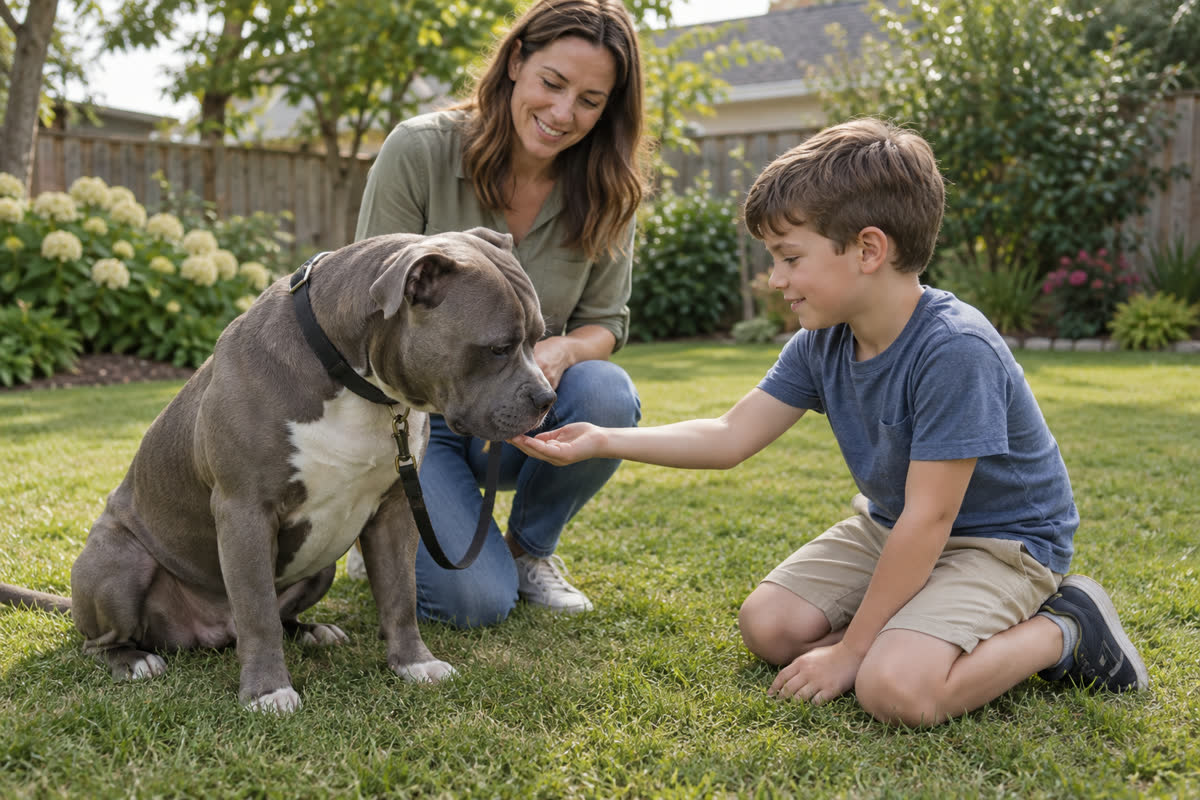
Most American Bullies bred to standard are affectionate and tolerant with children, which is exactly what both registries describe. But “good with kids” as a breed trait and “safe to leave alone with your kids” are different claims, and no responsible source collapses them into one. The CDC notes that children are bitten by dogs more often than adults, and the injuries tend to be more severe. Children should never be left to play with dogs unsupervised, even a dog they know. That guidance applies to every breed, and it applies with extra weight here because of size. An XL American Bully male (20-23 inches at the withers per the ABKC standard) can unintentionally knock down or overwhelm a toddler simply through size and enthusiasm. A Pocket-sized Bully (13-16 inches) generally can’t.
In practice that means never leaving young children and an American Bully together unsupervised, and teaching kids not to approach the dog while it’s eating or sleeping. It also means giving the dog a retreat space it can withdraw to, and matching your expectations to size class rather than assuming every American Bully carries the same physical risk. Regulators are starting to formalize versions of this same rule. UK government guidance states that, from November 1, 2026, England and Wales require adult supervision of children under 12 in close contact with an XL Bully in a private place such as a home or garden. This is part of the wider XL Bully ownership restrictions in force since February 1, 2024 (rules checked September 25, 2026; guidance page last updated September 16, 2026). That rule applies specifically in England and Wales, not everywhere the breed is kept. Bans and restrictions vary by country and even by city, so check local law before assuming it applies to you.
Are American Bullies good with other dogs?
The ABKC standard calls the American Bully friendly with other dogs and calls dog aggression highly undesirable; the UKC standard addresses aggression toward humans only. But “undesirable” is a judgment about what breeders should select against, not a claim that it never happens. Some American Bullies develop dog-selective behavior as they mature, for example toward dogs of the same sex. Resource guarding around food, toys, or a favorite person can also surface, even in an otherwise well-adjusted dog. Leash reactivity is also common enough to plan for, since a dog that’s relaxed off-leash at home can behave very differently when it feels restrained on a walk.
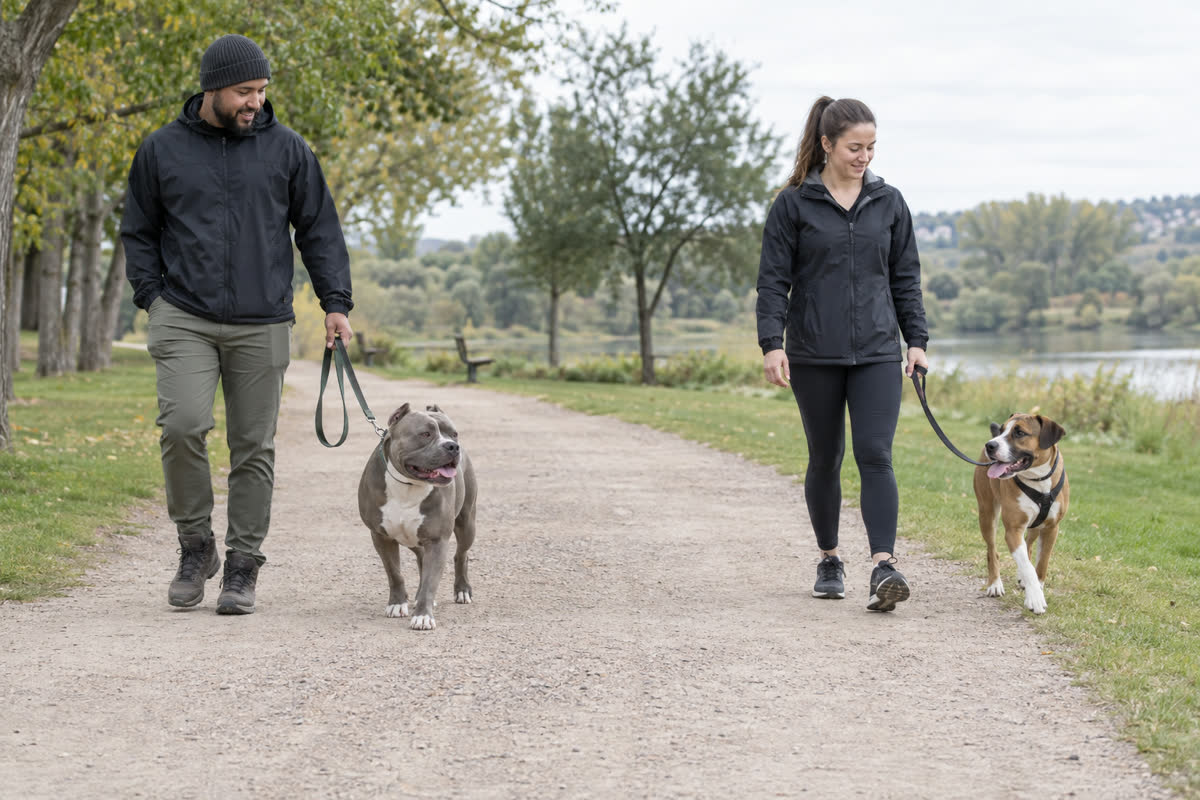
Introductions matter more than temperament claims. Meet on neutral ground rather than in either dog’s territory, and do a few parallel walks side by side before any face-to-face greeting. Keep the first direct meeting short and calm, and separate food and high-value toys until both dogs have a track record together. For the broader groundwork this depends on, socializing a pit bull-type dog around other dogs early and consistently reduces the odds of trouble later. The video below shows one practical approach to keeping an American Bully calm and responsive around other dogs during training.
If your dog already shows aggression toward other dogs or people, treat it as a training and safety issue to work through with a veterinarian or a certified dog behavior professional.
What about cats and small pets?
Neither standard addresses cats directly, and prey drive toward small animals varies by individual. Some American Bullies live peacefully with cats they were raised alongside; others should never be left unsupervised with one. Introduce gradually, on the cat’s terms, and manage the relationship rather than assuming it will work itself out.
How do American Bullies act with strangers?
The American Bully standard describes an outgoing dog, not a wary one — the UKC standard disqualifies extreme shyness outright, and the ABKC calls it highly undesirable. That tells you how strongly the breed is meant to lean toward confidence rather than suspicion. That also means the American Bully isn’t bred to be a natural guard dog. A dog that barks at or backs away from visitors is showing under-socialization or fear, not correct breed temperament. Fear-driven dogs are also the ones most likely to bite defensively, which is another reason confident, well-socialized behavior around unfamiliar people matters for safety, not just manners.
How do you raise a well-balanced American Bully?
Early socialization, starting in the first three months of life, is the biggest lever you control. According to the American Veterinary Society of Animal Behavior (AVSAB), that window is the primary and most important socialization period. Puppies can start socialization classes as early as 7-8 weeks old, with at least one set of vaccinations given at least seven days beforehand. Incomplete socialization raises the risk of later fear, avoidance, and aggression. Positive-reinforcement training started in that window, alongside controlled exposure to new people, dogs, sounds, and environments, does more to shape adult temperament than anything in the pedigree. For a fuller walkthrough of building those habits, see this site’s American Bully training basics.
How to judge temperament before you buy
- Meet both parents in person if the breeder allows it — temperament is heritable, and the parents are your best preview.
- Watch how the puppy and parents react to a stranger (you) — curiosity and quick recovery from a startle are good signs.
- Ask the breeder directly about the parents’ experience with other dogs, not just with people.
- Avoid puppies that seem persistently shy, frozen, or unusually reactive compared to their littermates.
- Ask for registry papers (ABKC or UKC) and confirm the parents meet the written standard rather than taking a sales page’s word for it.
Frequently Asked Questions
Do male or female American Bullies have a better temperament?
There’s no reliable data showing one sex has a better temperament across the breed. Individual variation, neutering status, and training consistency outweigh sex as predictors of how a specific dog behaves.
Are American Bullies good for first-time owners?
They can be, but they’re not a hands-off breed. A first-time owner willing to commit to early socialization, consistent training, and supervision around kids and other dogs can do well with one; someone looking for a low-maintenance dog should look elsewhere.
Is an XL Bully’s temperament different from a Pocket Bully’s?
Not according to the written standard — both are judged against the same temperament requirements. What changes with size is the consequence if something goes wrong: an XL’s size and strength make supervision and training lapses higher-stakes than they are with a Pocket.
Conclusion
The American Bully is bred to be gentle, confident, and outgoing. The ABKC disqualifies aggression toward people; the UKC disqualifies viciousness and extreme shyness outright and calls aggression toward humans highly undesirable. But breed explains only a fraction of how any single dog turns out, so the standard is a starting point, not a promise. If you’re choosing a puppy, meet the parents and ask about their history with people and other dogs. If you already have one, start socialization before the 12-week window closes, supervise every interaction with young children and other dogs, and match your expectations to your dog’s size class. From there, the training guide and the types hub linked above are the next practical steps.