
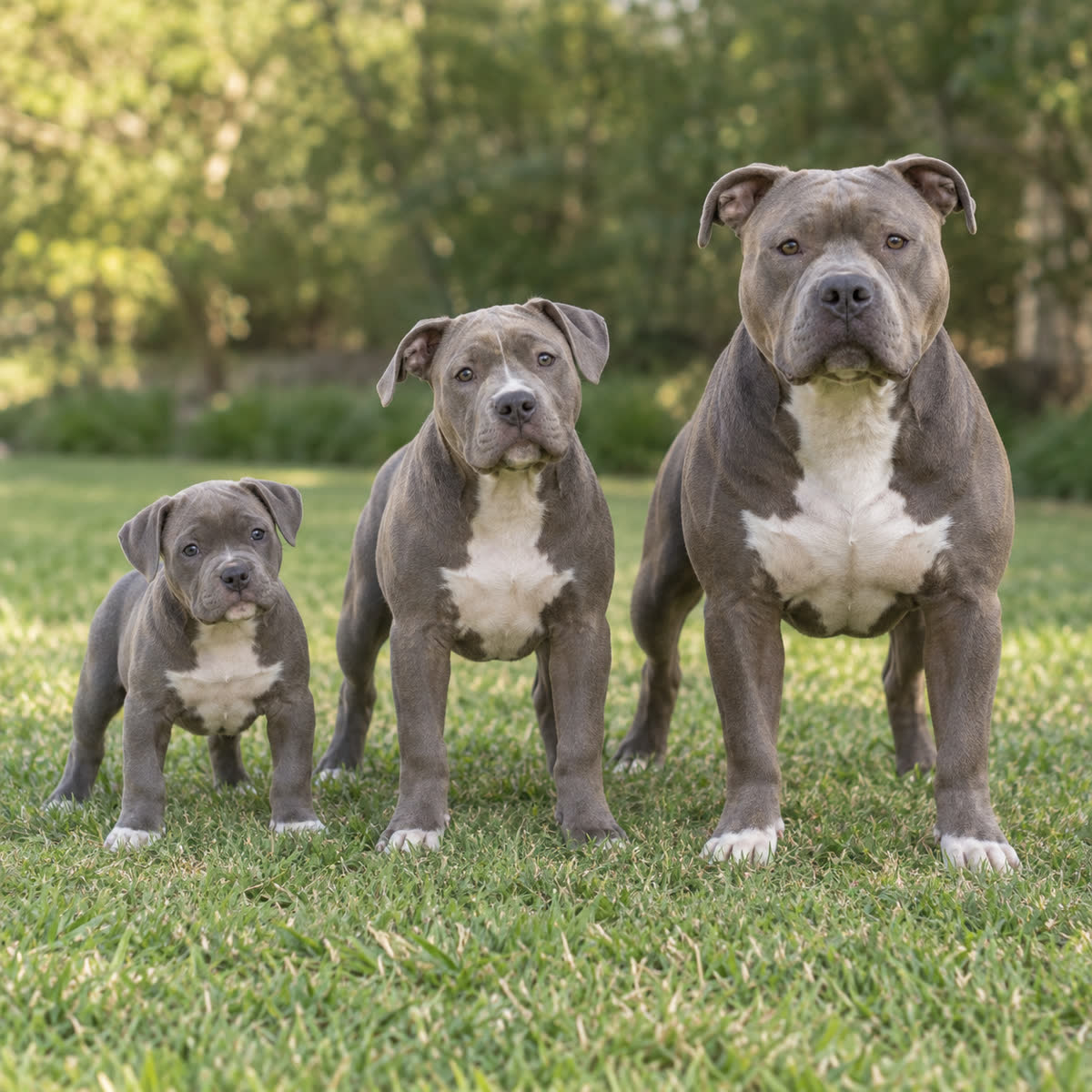
An American Bully weight chart can only ever show you an observed range, not an official standard. Neither the United Kennel Club nor the American Bully Kennel Club publishes a weight for any size class. Most Pocket Bullies land around 45 to 75 lb as adults, Standards around 70 to 120 lb, and XLs around 80 to 150 lb, once they finish filling out at 18 to 24 months. Below is the age-by-age chart, the adult ranges by class, and a way to check whether your own dog is on track rather than comparing it to a stranger’s average.
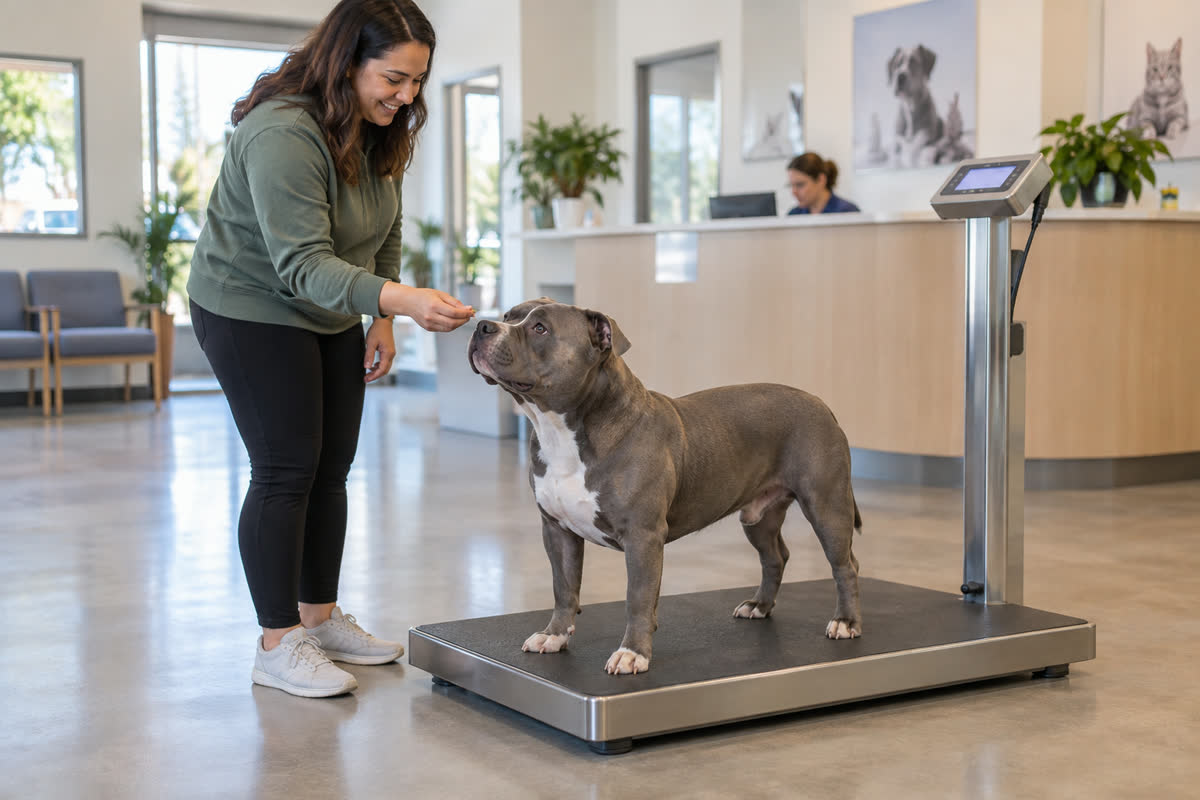
This article is educational and not a substitute for veterinary advice. Talk to your vet about any sudden weight change, growth that seems to have stalled, or limping in a growing puppy.
What should an American Bully weigh at each age?
Use the table below to check your puppy’s weight against reported ranges for its age — but treat every number as a starting point, not a target. The Pocket column comes from a breeder-published growth chart; no verified month-by-month data exists for Standard or XL Bullies, so those columns only fill in once the dog reaches adult size. Not sure which size class your dog falls into? The American Bully size classes guide breaks down the height standards for each one.
| Age | Pocket (lb) | Standard (lb) | XL (lb) |
|---|---|---|---|
| 8 weeks | 6-14 | No reliable data — track against your own dog | No reliable data — track against your own dog |
| 12 weeks | 10-20 | No reliable data — track against your own dog | No reliable data — track against your own dog |
| 16 weeks | 15-28 | No reliable data — track against your own dog | No reliable data — track against your own dog |
| 6 months | 25-45 | No reliable data — track against your own dog | No reliable data — track against your own dog |
| 9 months | 35-58 | No reliable data — track against your own dog | No reliable data — track against your own dog |
| 12 months | 40-68 | No reliable data — track against your own dog | No reliable data — track against your own dog |
| 18-24 months (adult) | 45-75 | 70-120 | 80-150 |
Observed ranges, not a registry standard. Pocket figures are breeder-reported via Venomline Bullies (checked September 2026); Standard and XL adult ranges are American Bully Daily’s commonly observed figures. No verified month-by-month data exists for Standard or XL Bullies — weigh your own dog every few weeks and judge the trend, not a single number against this table.
How much do adult Pocket, Standard, and XL Bullies weigh?
Adult weight depends on which size class your American Bully falls into, and even within a class there’s a wide spread. A Pocket American Bully commonly finishes around 45 to 75 lb — see the Pocket Bully guide for the height standard behind that class. A Standard American Bully typically lands between about 70 and 120 lb; the Standard Bully page covers its full height requirements. XL American Bullies are commonly reported at roughly 80 to 150 lb, reflecting their taller frame. Extreme is an ABKC-recognized class defined by a heavier build, not a separate height or weight range, while XXL is an unofficial, non-registry label — neither has a published weight range.
Why is there no official American Bully weight?
Because the breed’s own standard doesn’t set one. The United Kennel Club’s American Bully standard classes Pocket, Standard, Classic, and XL Bullies by height at the withers only, and gives no weight figure for any class. That gap is exactly why weight charts online contradict each other so badly: one widely cited chart lists adult Pocket Bullies at 11 to 22 lb, while a breeder-run chart puts the same class at 45 to 75 lb — a threefold difference for dogs supposedly meeting the same standard. Every number you see for American Bully weight, including the ones in this article, is an editorial or breeder-observed range, not a certified figure.
When does an American Bully stop growing?
Most American Bullies stop growing in height by around 12 months, then keep filling out in muscle and bone density for several months after that. The American Kennel Club notes that medium-sized breeds typically reach adult size around 12 months, while larger, heavier-boned dogs can keep growing until 18 months and sometimes longer. A useful way to check where your dog is in that process: if you can still feel the “knobs” of the ribs, the AKC’s Dr. Klein notes the dog will likely keep growing in height. Growth-standard research published in PLOS ONE (Salt et al., 2017), built from bodyweights of more than six million dogs, found that larger breeds can take up to 24 months to reach adult weight. But the study’s growth curves stop at 40 kg (about 88 lb) of adult weight, meaning many XL and XXL Bullies fall outside any validated growth curve entirely.
Is your Bully on track? A 5-step check
A single weight reading tells you very little on its own. A trend does. Run through this each time you weigh your dog:
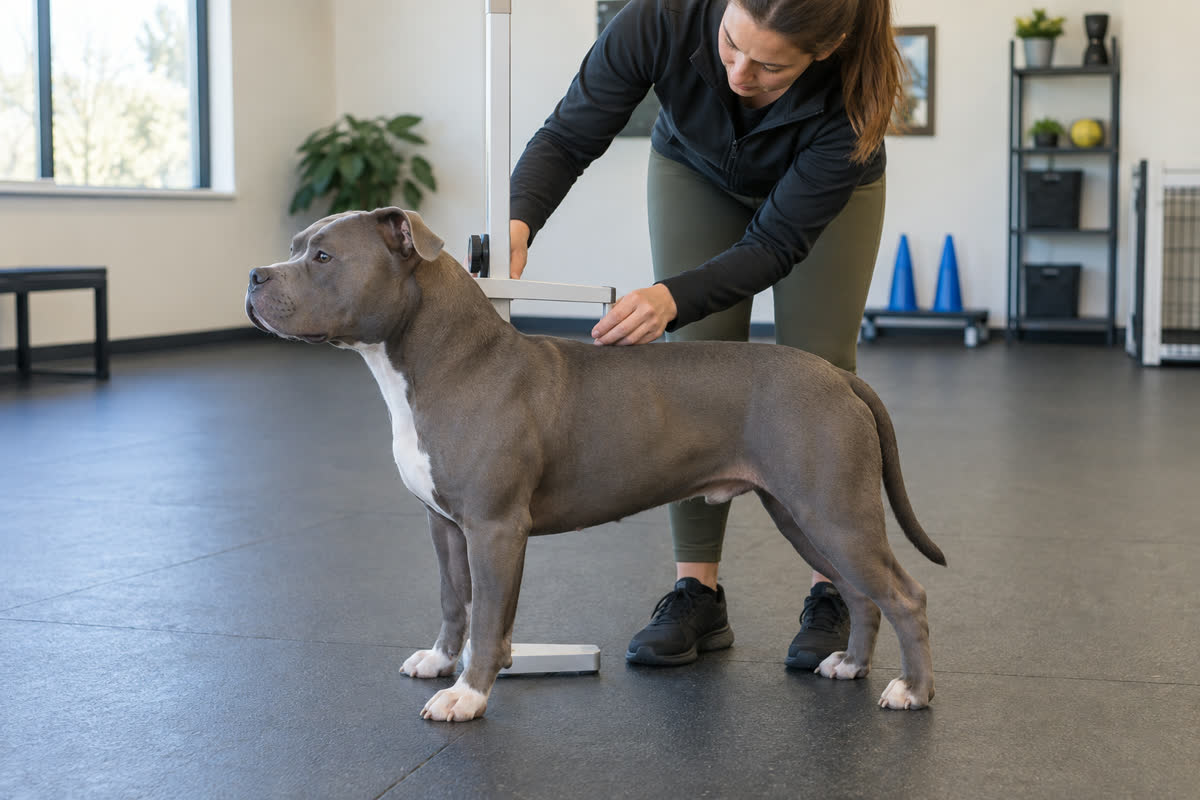
- Weigh your dog on the same scale every 2 to 4 weeks, at roughly the same time of day.
- Write the number down alongside the date — a phone note is enough.
- Check body condition score against the WSAVA 9-point scale: a score of 4 to 5 is ideal, meaning the ribs are easily felt with only a thin covering of fat, and a waist is visible from above.
- Do the rib-knob check described above — if the knobs are still easy to feel, expect more growth in height.
- Watch the trajectory over two or three readings rather than reacting to any single number, and see a vet if weight jumps or drops sharply or your puppy starts limping.
A vlogged example of one Pocket Bully’s growth, month by month, shows how much variation is normal for a single dog even within a class:
Why a leaner puppy grows into a healthier adult
Feeding for faster or bigger growth works against your dog, not for it. Rapid weight gain, weight outpacing height, and excess calcium are established risk factors for developmental orthopedic disease in large-breed puppies — which is why a diet formulated for large-breed growth, without extra calcium supplementation on top of a complete commercial food, matters more than pushing calories to bulk a puppy up. The clearest long-term evidence for lean feeding comes from a Labrador Retriever study (Kealy et al., 2002), where dogs fed 25% less from 8 weeks old lived significantly longer than their paired, normally fed counterparts — a median of about 1.8 years longer in that study. They also had a later onset of chronic disease. For what and how much to feed an American Bully at each life stage, see the American Bully food guide.
Do males and females weigh differently?
Registries only split American Bullies by sex on height, not weight — UKC standards put males about an inch taller than females at the top and bottom of each class’s range. No verified source publishes a male-versus-female weight split, so treat any number claiming to do so as unverified. In practice, males tend to run heavier and more heavily boned than females within the same size class, but the honest answer is that class and individual build matter more than sex alone.
Frequently Asked Questions
Does neutering affect an American Bully’s growth?
The Salt et al. 2017 growth-standard research found that any effect of neutering on growth curves was small compared with the natural variation between individual dogs. Talk to your vet about timing based on your dog’s own development rather than growth alone.
Can you predict an American Bully’s adult size from its paws?
No reliable evidence supports the paw-size myth. A better read is your dog’s parents’ size, its size class, and the rib-knob growth check described above.
When should an American Bully switch to adult food?
Timing depends on size class and how your individual dog is growing rather than a fixed age — see the American Bully food guide for feeding by life stage.
Conclusion
There’s no certified American Bully weight chart because there’s no certified American Bully weight — only observed ranges that vary by size class and by dog. Weigh your puppy every few weeks, score its body condition against the WSAVA scale, and watch the trend rather than chasing a number from a stranger’s chart. If a reading jumps, stalls, or your dog starts favoring a leg, that’s a conversation for your vet, not a spreadsheet.