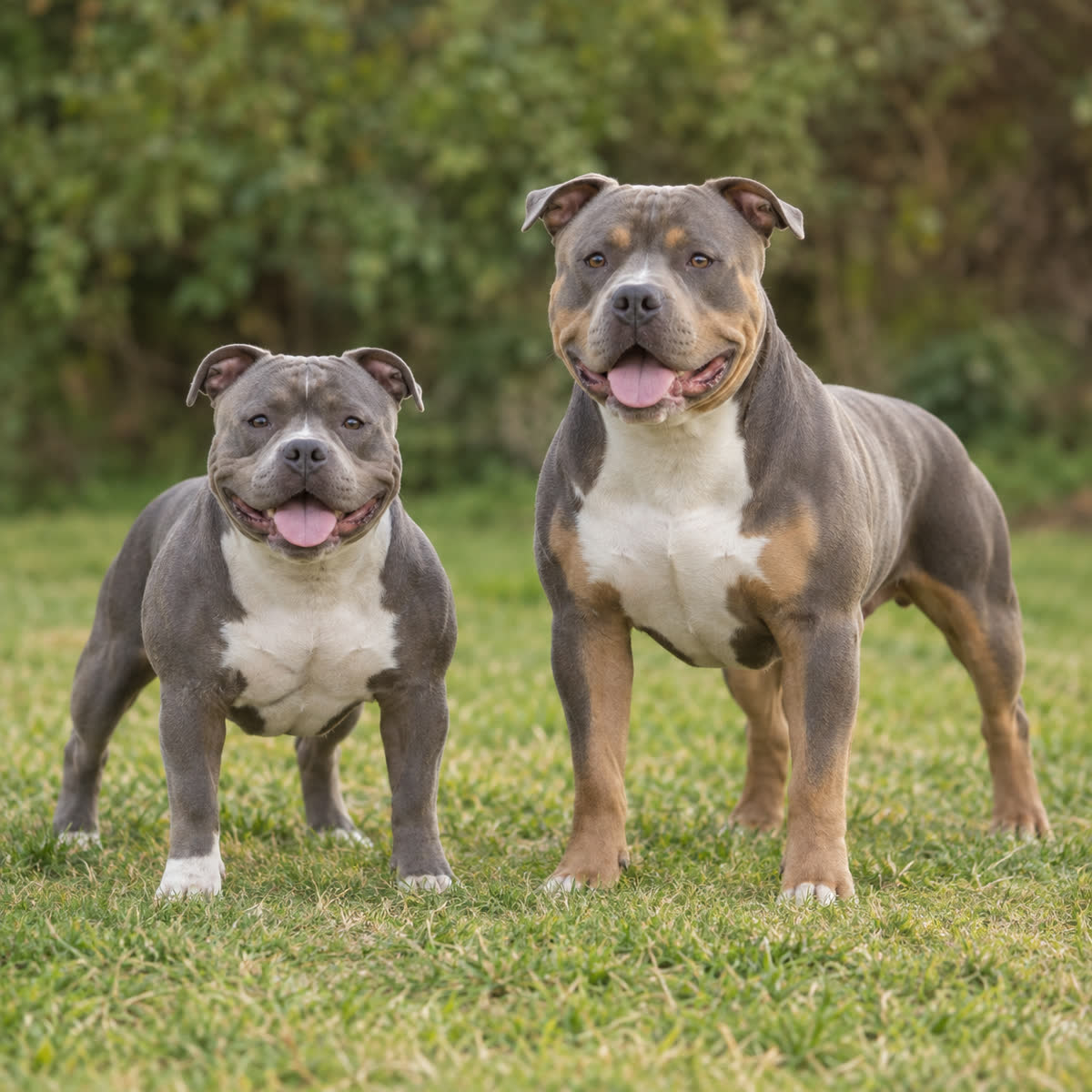
A micro bully is an American Bully bred and marketed shorter than the official Pocket minimum, and no kennel club recognizes “micro” as a size class. If you want a small, registrable, standard-backed dog, a Pocket Bully is the safer starting point. If you still want a micro, the parents’ actual measurements and a DNA test matter far more than the label on the listing.
What exactly is a micro bully?
The micro bully is an informal breeder label, not an American Bully variety. Breeders apply it to dogs they judge or advertise as smaller than a Pocket Bully, the smallest variety the American Bully Kennel Club (ABKC) and United Kennel Club (UKC) actually recognize. Because there is no standard behind the word, “micro” means whatever the seller wants it to mean on a given listing, and the same dog could be called a small Pocket by one breeder and a micro by another. For the full breakdown of how Pocket, Standard, Classic, and XL fit together, see our guide to American Bully types and sizes.
How tall is a micro bully compared with a Pocket?
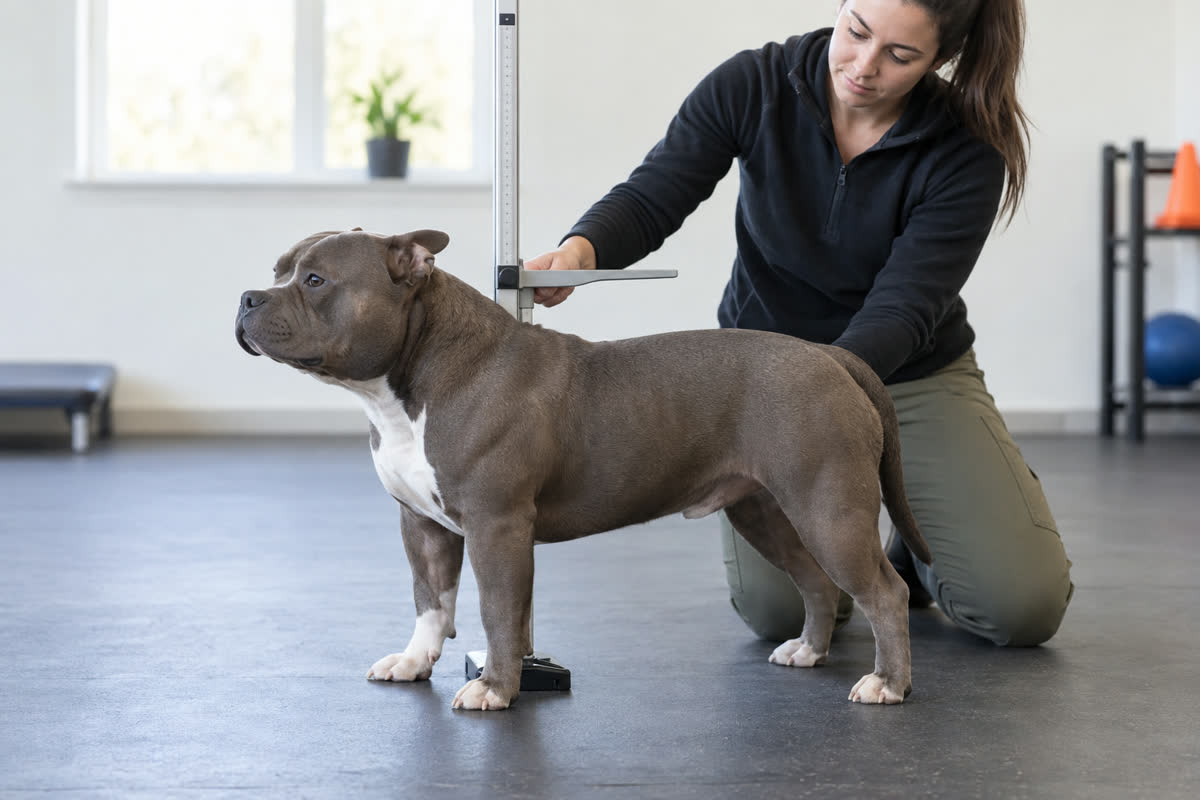
A micro bully is usually marketed as a dog measuring below the Pocket minimum, since no registry sets a floor for “micro” at all. The ABKC breed standard calls for males under 17 in (43 cm) and no less than 14 in (36 cm) at the withers, and females under 16 in (40 cm) and no less than 13 in (33 cm). The UKC American Bully standard matches those Pocket numbers exactly, with males from 14 in up to under 17 in and females from 13 in up to under 16 in. Anything a breeder calls a micro typically falls under those minimums — under roughly 14 in for a male, under 13 in for a female — but because the label isn’t standardized, treat any specific number in a listing as a claim to verify, not a guarantee.
Our Pocket American Bully guide covers the Pocket’s full temperament and care picture; the table below is only for comparing heights and registry status side by side.
| Trait | Micro Bully | Pocket Bully | Shorty Bull |
|---|---|---|---|
| Registry status | Not recognized (informal label) | Recognized by ABKC and UKC | Recognized by ABKC as a separate breed |
| Male height | No standard; usually under ~14 in | 14 in to under 17 in | 15 in and under (over is a DQ) |
| Female height | No standard; usually under ~13 in | 13 in to under 16 in | 15 in and under (ABKC gives no separate female figure) |
| Body structure | Varies; often shorter-legged than a Pocket | Compact but proportionate to the American Bully standard | Compact, muscular; long legs or fine bone is a fault |
| Main health watch-points | Leg/spine and joint concerns tied to extreme shortness (see below) | Same general American Bully health checks as other sizes | Breed-specific checks; no dedicated health data reviewed here |
| Typical asking price | Mostly $1,500-$4,000 on one US marketplace snapshot (2026-09-25) | Varies widely by bloodline and breeder | Not covered in this guide |
Do the kennel clubs recognize the micro bully?
No. Neither the ABKC nor the UKC standard uses the word “micro” anywhere. ABKC recognizes four size varieties — Pocket, Standard, Classic, and XL — plus Extreme as a show class with no height given, while UKC groups Standard and Classic together under one class alongside Pocket and XL.
What the ABKC and UKC standards say
The ABKC standard sets Standard and Classic males at 17-20 in and females at 16-19 in. XL males run over 20 up to 23 in, and XL females over 19 up to 22 in, with Pocket as the floor described above. The UKC groups Standard and Classic together, setting its own XL range at over 20 up to 23 in for males and over 19 up to 22 in for females. UKC recognized the American Bully as a breed on July 15, 2013. Critically, the UKC standard lists dwarfism as a disqualification. It also disqualifies any “height so far from what is desired as to compromise health, structure, movement, and physical ability” — language that describes exactly the territory a deliberately bred micro occupies.
The Shorty Bull: a registered short bully breed
Buyers considering a very small bully-type dog should also know about the Shorty Bull, a registry-recognized short-stature bulldog breed — not a smaller American Bully. ABKC registers it as its own breed, described as a compact and muscular bulldog of small stature, capped at 15 in at the shoulder — anything taller is a disqualification — with long legs or fine bone marked as a serious fault. That 15 in cap sits inside the Pocket American Bully’s own male range (14 in to under 17 in), so a Shorty Bull isn’t necessarily smaller than a Pocket; it’s simply a different breed with its own standard.
What health problems come with breeding a bully this small?
This section is educational and not a substitute for veterinary advice. Talk to a vet about any dog’s individual health risks.

Short legs and the CDDY gene
Short-legged, chondrodystrophic body types in dogs are linked to specific FGF4 retrogene insertions: one on chromosome 18 (CDPA) and one on chromosome 12 (CDDY) — the mechanism identified in peer-reviewed research published in PNAS, the same genetics documented in short-legged breeds like the Dachshund, Basset Hound, and Corgi. CDDY doesn’t just shorten legs — a single copy is enough to raise the risk of Hansen type I intervertebral disc disease (IVDD), a painful and sometimes disabling spinal condition, and dogs carrying both variants tend to be shorter still. There’s no published study establishing how common these variants are specifically in American Bullies, so it would be wrong to say micro bullies carry them. But if a breeder is deliberately selecting for shortness, this is the genetic mechanism most likely involved, and a combined CDDY/CDPA DNA test from the UC Davis Veterinary Genetics Laboratory exists to check a specific dog rather than guess.
Joints and movement
UK vets report seeing micro and pocket-type bullies with hip and elbow dysplasia, carpal hyperextension, and proprioceptive problems in practice, though this is practitioner observation rather than a formal prevalence study. Hip and elbow scoring through a program like OFA before breeding is the standard way to check a specific dog’s joints rather than relying on how compact it looks.
Breathing and heat
The ABKC standard itself states the muzzle must not be so short that it interferes with normal breathing, which points at the same brachycephalic airway concern (BOAS) that affects other flat-faced breeds. The British Veterinary Association’s policy on extreme conformation is direct: animals showing extremes of conformation that negatively affect health and welfare should not be bred, citing breathing difficulties, arthritis, and compromised mobility as the kinds of problems that follow. A dog bred toward an extreme micro size can combine a shortened muzzle with a shortened, less structurally sound frame.
What about lifespan?
There’s no reliable, evidence-based data specific to micro bully lifespan, and claims of a shortened lifespan circulating online aren’t sourced to anything verifiable — so this guide won’t repeat a number it can’t back up. If lifespan matters to your decision, ask a breeder for OFA and DNA test results on the parents rather than a lifespan figure for the “type.”
How much does a micro bully cost?
There’s no universal, evidence-based price for a micro bully, and any number quoted without a dated source should be treated with skepticism. A snapshot of one large US marketplace, Lancaster Puppies, on 2026-09-25 showed 37 listings under “micro” American Bully, with most puppies asking $1,500-$4,000, and outliers ranging from an $800 twelve-week-old male up to an $8,000 adult male. These are asking prices on one US site, not confirmed sale prices, and they’ll vary by country and change over time — a higher price is not evidence of better health or a more legitimate breeding program.
Micro or Pocket: which should you choose?
A Pocket Bully is the better choice for most buyers who want a small American Bully: it’s bred to an actual height standard, and it can be shown and registered as what it is. Reputable Pocket breeders are also working within a range that doesn’t require pushing a dog toward the disqualifying extremes the UKC standard warns against. A micro makes sense only if you understand you’re buying outside any standard, and you’re prepared to vet the breeding stock yourself rather than trust the label. If it’s the distinctive heavy-boned exotic look you’re after rather than small size specifically, know that “exotic” is another informal label — for an exaggerated build (bigger head, wider chest, shorter muzzle, heavy bone) rather than a recognized ABKC/UKC variety — and many dogs sold as exotic are also very short, so the two labels overlap. See the famous dogs in our exotic bully list for that side of the breed.
Questions to ask a micro bully breeder
- Measure both parents at the withers yourself, in person or on video with a measuring stick against them — don’t take a breeder’s word for their height.
- Ask for CDDY/CDPA DNA test results on both parents, not just the puppy.
- Ask for OFA hip and elbow results on both parents.
- Watch both parents walk and trot, and watch them breathe after light exercise.
- Ask for registry papers and what size variety the parents were actually registered or shown as.
- Walk away from any breeder who “guarantees” a puppy’s adult size — no breeder can promise that.
Frequently Asked Questions
How long do micro bullies live?
There’s no reliable, micro-specific lifespan data. The American Bully as a whole is commonly cited at 10-12 years; a dog bred toward an extreme small size may carry additional health risks discussed above, but no verified number exists for micros specifically.
Can a micro bully be registered?
Yes — an American Bully is registered based on its parents’ pedigree, not its size, so a micro-sized dog can be registered as an American Bully if its parents are registered. There is no separate “micro” category. In the show ring, though, a dog below the Pocket minimum falls outside every recognized standard and can be disqualified under UKC’s rules on dwarfism and health-compromising height.
Is an exotic bully the same as a micro bully?
Not exactly, though they overlap. “Exotic” is another informal label — for an exaggerated build (bigger head, wider chest, shorter muzzle, heavy bone) — and many dogs sold as exotic are also very short. Neither “exotic” nor “micro” is a recognized ABKC/UKC variety; see our exotic bully list for that side of the breed.
Are micro bullies good family dogs?
Temperament in a micro bully is American Bully temperament — size doesn’t change that. The bigger factor for a family is the individual dog’s health and mobility, which is exactly why vetting the parents matters more than the size label.
Conclusion
“Micro bully” describes a marketing choice, not a recognized size. The closer a dog is bred toward the extremes that label implies, the more it risks running into the same structural and breathing problems the UKC standard explicitly disqualifies against. A Pocket Bully gives you a small American Bully with an actual standard behind it, which is why it’s the starting point for most buyers. If a micro is still what you want, don’t buy on the label — measure the parents yourself, ask for a CDDY/CDPA test and OFA results, and treat any “guaranteed size” claim as a reason to look elsewhere.