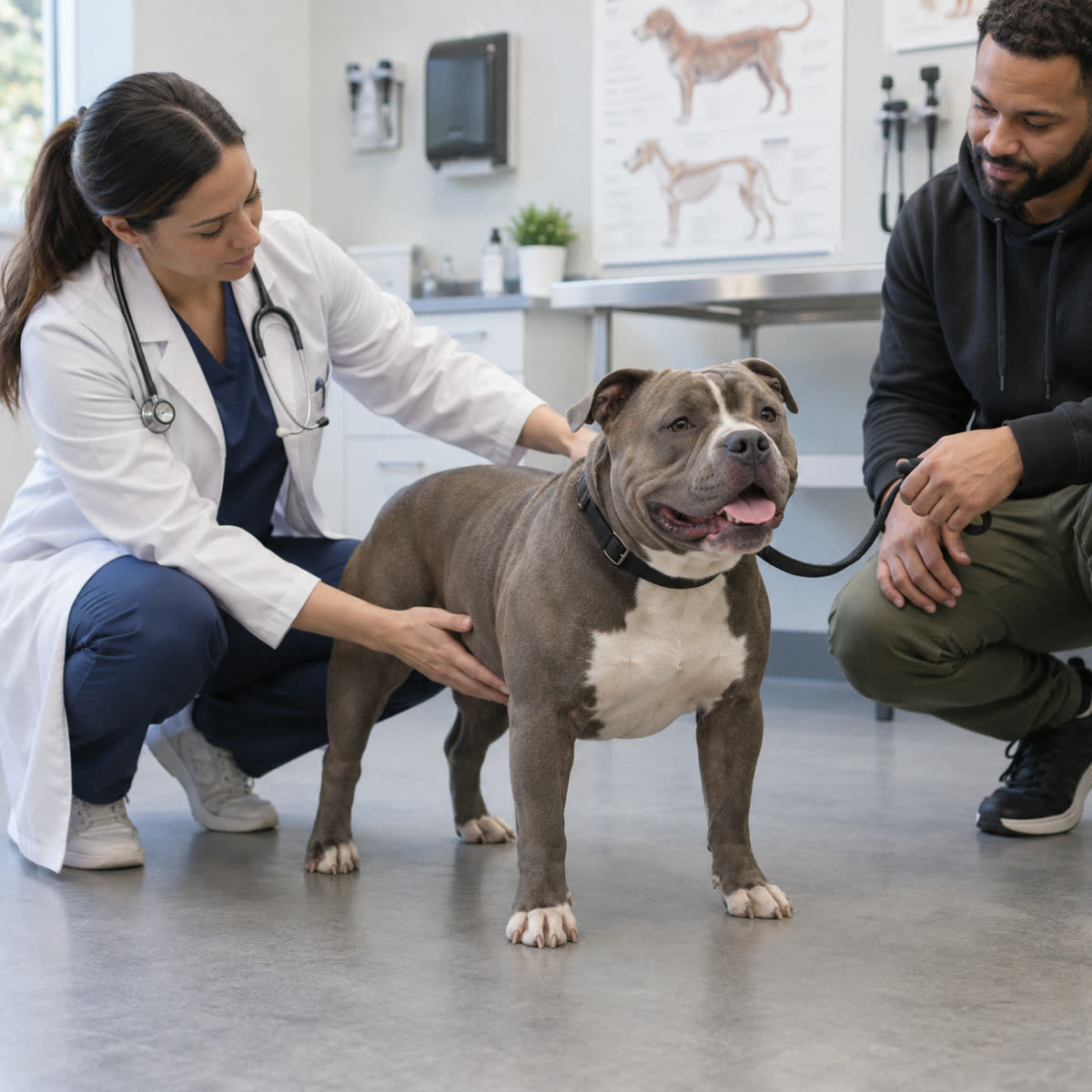
Joint disease is the American Bully’s biggest documented health risk: screening records show 44% of tested Bullies have hip dysplasia and roughly 39% have elbow dysplasia, close to double the rate of the breeds it descends from. Heart, skin, dental and heat problems follow behind, each with its own warning signs and its own health test. This guide walks through what the screening data actually shows, what to watch for at home, and which tests to ask a breeder for before you commit to a puppy.
This article is educational, not veterinary advice. If your dog shows any of the warning signs below, book a vet exam rather than waiting on a diagnosis from an article.
Which health problems show up most in screened American Bullies?
Orthopedic disease dominates the American Bully’s screening record, followed by dental and cardiac findings, with skin and eye problems trailing well behind. The Orthopedic Foundation for Animals (OFA) runs the largest public database of canine health screening results in the US. Breeders and owners submit X-rays, exams and DNA panels, and OFA publishes the pass/fail breakdown by breed. These are not random-sample statistics — they only cover dogs whose owners chose to screen them — but at close to 1,000 evaluations for hips alone, the American Bully numbers are large enough to show a clear pattern, though they describe screened dogs, not every American Bully. For a primer on how the breed’s size classes differ before you read the risk breakdown below, see our guide to the American Bully’s size classes.
| Test | Dogs screened | % abnormal | What it means for an owner |
|---|---|---|---|
| Hips | 930 | 44.0% | The single biggest documented risk in the breed. See the section below. |
| Elbows | 866 | 38.7% | Almost as common as hip dysplasia, and often screened alongside it. |
| Dentition | 110 | 20.9% | Missing teeth or bite faults — more common than most owners expect. |
| Advanced cardiac | 347 | 7.5% | Structural heart findings on echocardiogram; worth screening before breeding. |
| Eyes | 303 | 4.0% | Low compared to joints — not a major breed concern. |
| Patella | 593 | 1.9% | Kneecap luxation is rare in this breed’s screening record. |
| Basic cardiac | 404 | 1.2% | A stethoscope-level heart exam; abnormal results are uncommon. |
| Thyroid | 88 | Not reported (96.6% normal) | Small sample; not enough data to call this a breed predisposition. |
Source: OFA disease statistics, American Bully data as of September 25, 2026.
| Breed | Hips % dysplastic (evals) | Elbows % abnormal (evals) |
|---|---|---|
| American Bully | 44.0% (930) | 38.7% (866) |
| American Staffordshire Terrier | 25.7% (4,303) | 18.3% (1,614) |
| American Pit Bull Terrier | 22.3% (1,189) | 17.0% (587) |
Source: OFA disease statistics, as of September 25, 2026.
Why do American Bullies get hip and elbow dysplasia so often?
The American Bully’s heavier, more muscled build carries roughly double the joint disease rate of the American Pit Bull Terrier and American Staffordshire Terrier lines it was bred from. In the same OFA database, 22.3% of American Pit Bull Terriers and 25.7% of American Staffordshire Terriers screened dysplastic on hips, against 44.0% for the American Bully. Elbows follow the same pattern: 17.0% for the APBT, 18.3% for the AmStaff, and 38.7% for the American Bully. A heavier frame loads the hip and elbow joints more during growth, and rapid early weight gain compounds the risk — the same dynamic that pushes oversized dogs toward more joint problems, covered in more detail in our guide to the joint risks of oversized XXL Bullies.
Signs of hip or elbow dysplasia to watch for
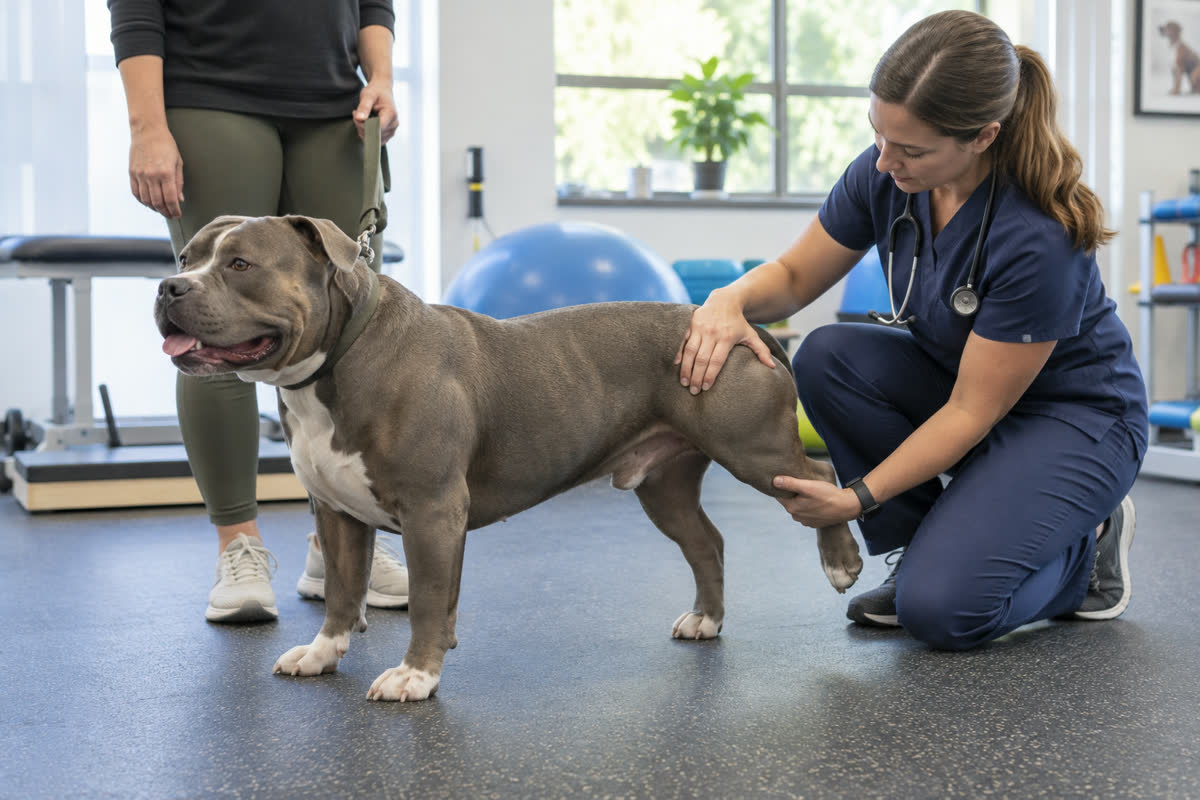
Bunny-hopping when running, stiffness after rest that eases with movement, reluctance to climb stairs or jump into a car, and visible muscle loss in the hindquarters or front legs are the earliest signs owners tend to notice. None of these confirm dysplasia on their own — only an X-ray does — but any of them is a reason to book a vet exam rather than wait.
What OFA hip and elbow grades mean
OFA grades hips on a seven-point scale from Excellent through Severe. Excellent describes a deep-seated ball that fits tightly into a well-formed socket; Good is slightly less ideal but still congruent; Fair shows minor irregularities with a wider-than-normal joint space; Borderline results are inconclusive; and Mild, Moderate and Severe describe increasing degrees of subluxation, down to a ball that sits only partly, or not at all, inside a shallow socket.
Can an American Bully tear a knee ligament?
Yes — cranial cruciate ligament (CCL) disease, the canine equivalent of an ACL tear, is a documented risk in the Staffordshire Terrier line the American Bully descends from. A heavier build plausibly adds load, though ACVS doesn’t list the American Bully by name. The American College of Veterinary Surgeons (ACVS) lists the Staffordshire Terrier among predisposed breeds, alongside the Rottweiler, Newfoundland, Mastiff, Akita, Saint Bernard, Chesapeake Bay Retriever and Labrador Retriever. Signs include difficulty rising from a sit, trouble jumping into a car, a drop in activity level, lameness that varies in severity, muscle loss in the affected leg, and sometimes a popping or clicking sound that can point to a torn meniscus. ACVS states that surgery — most often TPLO, TTA, or a suture-based stabilization — is typically the best treatment for a full tear. Non-surgical management (pain medication, exercise changes, joint supplements, rehab, and bracing) is also an option, though ACVS considers surgery the better treatment for most dogs. No treatment costs are included here, since none could be independently verified — ask your vet for a current quote.
What skin and ear problems affect American Bullies?
Allergic skin disease, most often atopic dermatitis, is the main skin concern in the wider bull-breed family the American Bully belongs to. A 2020 VetCompass study of 1,304 Staffordshire Bull Terriers against 21,029 other UK dogs found the Staffordshire Bull Terrier had significantly higher odds of atopic dermatitis (odds ratio 1.88), skin masses (1.80), seizure disorders (2.06) and general stiffness (1.76) than the wider dog population. That study is on a closely related breed, not the American Bully itself, so treat it as a family-level risk signal rather than a confirmed Bully statistic. It still lines up with what allergy-prone skin looks like in practice: chronic paw licking, face rubbing, recurring hot spots, and ear infections that keep coming back. Inflamed, allergic skin inside the ear canal is an easy target for yeast and bacteria. Recurring ear infections in a dog with no other cause are worth a dermatology workup rather than repeat rounds of ear drops.
How serious is heart disease in American Bullies?
Heart disease is a real but secondary risk in the American Bully, well behind joint disease in scale. OFA’s basic cardiac exam — a stethoscope-level check — came back abnormal in only 1.2% of 404 American Bullies screened, with a further 1.2% equivocal. The more sensitive advanced cardiac exam, which uses echocardiography, found abnormal results in 7.5% of 347 dogs screened. That gap matters: a claim circulating online says the American Bully ranks as the single worst breed for basic cardiac results. That doesn’t hold up against OFA’s own current numbers, where the breed ranks 4th rather than 1st, and 97.5% of basic exams come back normal (1.2% abnormal). If a breeder offers only a stethoscope check, ask whether an echocardiogram-based exam is available — it catches structural issues a basic exam misses.
Why do so many American Bullies fail dental screening?
Nearly 21% of American Bullies screened through OFA’s dentition database came back abnormal, for faults such as missing teeth or a misaligned bite. That’s a higher failure rate than most owners expect from a “dental” category, and it’s rarely mentioned on other breed health pages. Missing teeth and bite faults are largely structural and aren’t fixed by brushing, but routine dental care — brushing, dental chews, and a vet check of the mouth at annual visits — still matters for preventing periodontal disease on top of whatever structural issues are already there.
How does heat and breathing affect a heavy-built Bully?
A heavy, muscular body with a short muzzle sheds heat less efficiently than a leaner, longer-muzzled dog, which puts the American Bully at higher risk of overheating in hot weather or during exercise. Watch for heavy panting that doesn’t ease with rest, noisy or labored breathing, gum color changes, or any sign of collapse — these need an emergency vet, not a wait-and-see approach. We cover the specific temperature thresholds, cooling methods and exercise timing in detail in how to keep an American Bully cool in summer.
How does weight change an American Bully’s health?
Extra body weight loads an already dysplasia-prone skeleton harder, which makes weight management one of the few risk factors an owner can actually control. Muscle mass is not the same as fat, and a heavily muscled Bully can still be overweight — rib and waist checks matter more than a number on a scale. For more on how supplements fit into a broader joint-health plan alongside weight control and screening, see our honest breakdown in our roundup of American Bully vitamins and supplements.
Which health tests should you ask an American Bully breeder for?
A breeder who has actually health-tested their breeding dogs will have documented results you can verify yourself — “vet checked” is not a health test. Ask for:
- OFA (or BVA/KC scheme, for UK breeders) hip evaluations on both parents, with the grade stated.
- OFA (or BVA/KC) elbow evaluations on both parents.
- A cardiac exam — ask specifically whether it was a basic (auscultation) or advanced (echocardiogram) exam.
- Patella evaluation on both parents.
- An eye exam from a veterinary ophthalmologist.
- Registration or certificate numbers you can look up yourself on ofa.org, rather than taking a breeder’s word for the result.
UK readers should ask for the equivalent BVA/KC hip and elbow scheme results, since OFA is a US-based registry.
Warning signs and what to do next
This table is a starting point for deciding how urgently to act — it doesn’t replace a vet’s judgment on your specific dog.
| Warning sign | Likely area | What to do |
|---|---|---|
| Bunny-hopping gait, stiffness after rest | Hips or elbows | Vet exam and X-ray; don’t wait for it to worsen |
| Sudden hind-leg lameness, especially after activity | Cranial cruciate ligament | Vet exam within days — a partial tear can progress to a full tear |
| Chronic paw licking, recurring ear infections | Allergy / atopic dermatitis | Vet dermatology workup rather than repeat topical treatment |
| Noisy breathing, heavy panting that won’t ease, collapse in heat | Airway / heatstroke | Emergency vet immediately |
| Loose or missing teeth, bad breath, reluctance to chew | Dental | Vet dental exam and cleaning |
Frequently Asked Questions
How long do American Bullies live?
No published study has measured the American Bully’s lifespan specifically, so any number you see quoted online is an estimate, not a documented figure. What research does show is that larger and shorter-muzzled breeds tend to live shorter lives on average than smaller, longer-muzzled ones — a pattern relevant to the Bully’s build and the same gap in the data flagged in our XXL guide.
At what age can you test a Bully’s hips?
OFA offers preliminary hip and elbow screening from 4 months of age. Final, certifiable ratings are issued once the dog reaches adulthood — ask a breeder specifically whether the results they’re showing you are preliminary or final.
Are Pocket Bullies healthier than XL Bullies?
No study has isolated health outcomes by American Bully size class specifically. What the joint-disease data does show is that a heavier frame loads joints harder, so a smaller, lighter build is reasonable to expect to carry less mechanical stress — but that’s an inference from body-weight mechanics, not a size-class study. Our guide to oversized XXL Bullies covers how oversizing specifically raises joint risk.
Do vitamins or supplements prevent joint problems?
No. Joint supplements are listed by ACVS only as part of non-surgical management for dogs that already have joint disease — they don’t prevent or reverse dysplasia. They can be a reasonable part of a broader joint-health plan alongside weight control and screening, as covered in our roundup of American Bully vitamins and supplements linked above.
Conclusion
The American Bully’s biggest health risk by far is orthopedic, with hip and elbow dysplasia rates roughly double those of its ancestor breeds, followed by real but smaller risks in dentition, cardiac health, skin and heat tolerance. The single best thing you can do before buying a puppy is ask for OFA (or BVA/KC) hip, elbow, cardiac and patella results on both parents and verify them yourself rather than taking a breeder’s word for it. If you already own a Bully, a baseline orthopedic exam — even before symptoms appear — gives you and your vet a reference point for anything that changes later. Pair that with weight management and prompt attention to the warning signs above, and you’re addressing the risks the data actually supports, not the ones that get repeated without evidence.