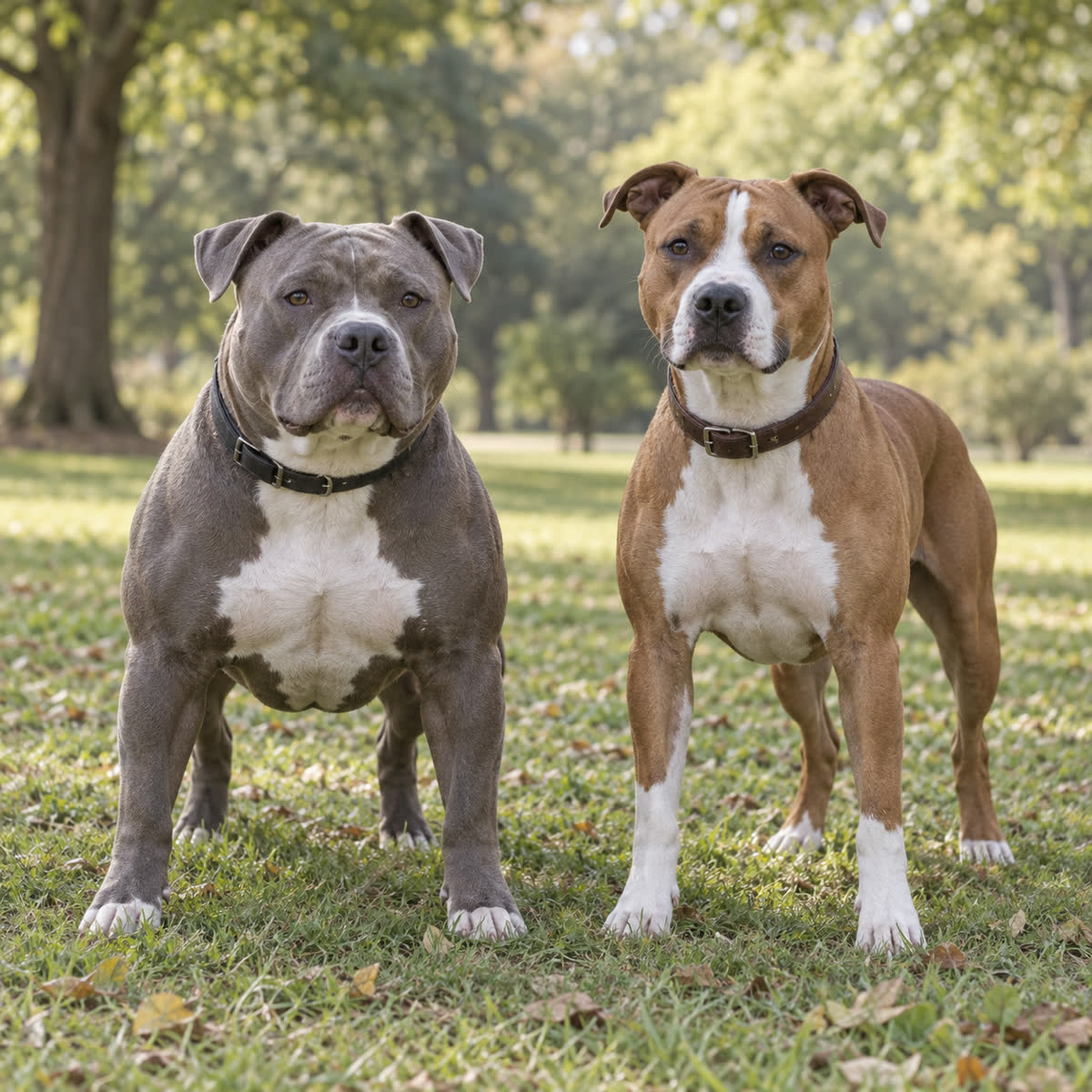
American Bully vs American Staffordshire Terrier comparisons get muddled fast because both dogs share bull-and-terrier ancestry and both get called “pit bull” by strangers on the street. The American Staffordshire Terrier (AmStaff) is an American Kennel Club breed built as an agile, athletic terrier and standardized in 1936. The American Bully is a much younger companion breed, developed from the 1980s through the 1990s and recognized by the ABKC in 2004 and the UKC in 2013, bred toward heavier muscle, a blockier head, and four separate size varieties.
Why do people mix up the AmStaff, the Staffy and the American Bully?
Four different dogs get lumped under “pit bull” in casual conversation, and sorting them out solves most of the confusion in this comparison. The American Pit Bull Terrier (APBT) is the UKC-registered working terrier that sits at the root of the bull-and-terrier group. The American Staffordshire Terrier is the AKC’s version of that same foundation stock, split off and standardized separately. The Staffordshire Bull Terrier is a distinct, smaller British breed that is frequently confused with both the AmStaff and the Bully in blog posts and video comparisons — if a source is comparing “Staffy vs Bully,” it is very likely talking about a different dog than the one in this article. The American Bully is the newest of the four, built on Pit Bull Terrier and AmStaff-type lines with later infusions of bulldog breeds. For a broader map of where each of these fits, see our rundown of the types of pitbulls, and for a direct comparison against the breed the Bully is most often confused with, read how the American Bully differs from the American Pit Bull Terrier.
American Bully vs AmStaff at a glance
The table below lines up both breeds by the attributes buyers ask about most: recognition, size standard, build, and health protocol.
| Attribute | American Staffordshire Terrier | American Bully |
|---|---|---|
| Recognized by | AKC (as “Staffordshire Terrier” in 1936; renamed 1969) | ABKC (2004), UKC (2013) — not AKC |
| Breed purpose | Agile terrier, historically a working and show breed | Companion breed, bred for temperament and build over working drive |
| Height standard | Single band: ~18–19 in (male), ~17–18 in (female), preferred | Four varieties (Pocket, Standard, Classic, XL); Classic shares Standard’s heights with a lighter frame |
| Weight standard | None set — AKC standard says only “height and weight should be in proportion” | None set — ABKC standard states “there is no particular weight for the breed” |
| Build | “Stocky, not long-legged or racy,” agile and graceful | Compact, heavily muscled, blockier head and frame |
| Ears | Cropped or uncropped, uncropped preferred | Natural or cropped (ABKC) |
| Tail | Not docked | Docked/bobbed/screwed tail disqualifies (UKC, ABKC) |
| Color rules | Most colors allowed; all-white, >80% white, black-and-tan, and liver “not to be encouraged” | ABKC: all colors and patterns permitted; UKC disqualifies merle and blue eyes |
| Registry health protocol | STCA recommends hip, cardiac, thyroid, NCL-A and ALPP testing | No parent-club testing protocol — ask individual breeders for OFA/PennHIP and DNA results |
| Typical lifespan | Commonly cited around 12–13 years | Commonly quoted as 10–12 years; no large population study yet |
| UK legal status | The England & Wales ban is based on an official physical definition, not breed name — any dog meeting it is covered | Subject to the England & Wales XL Bully ban if it meets the official physical definition |
Where did each breed come from?
The AmStaff descends from bull-and-terrier stock the AKC standardized as a separate breed in 1936; the American Bully is a much younger companion breed developed in the 1990s from American Pit Bull Terrier and AmStaff-type lines.
The AmStaff: AKC’s Staffordshire Terrier since 1936
The American Kennel Club recognized this breed in 1936 under the name “Staffordshire Terrier,” a date confirmed in the AKC’s official breed standard. The name changed to American Staffordshire Terrier effective January 1, 1969, specifically to separate it from the British Staffordshire Bull Terrier, which is a different breed despite the similar name. In its early decades, the AKC’s stud book was reopened to UKC-registered American Pit Bull Terriers on several occasions, which is why the two breeds still share so much of their genetic base even though they have been bred to separate standards for most of a century.
The American Bully: a companion breed from the 1990s
The American Bully emerged later, built mainly on American Pit Bull Terrier and AmStaff-type lines, with later infusions of American Bulldog, English Bulldog and Olde English Bulldogge blood. The ABKC has registered the breed since 2004, and the UKC recognized the American Bully as a breed on July 15, 2013. Breeders often trace specific lines back to foundation kennels — if you’re evaluating a puppy or a stud, it’s worth reading up on which American Bully bloodlines breeders still reference today, since bloodline reputation varies a lot more than the written standard does.
How do their size and build compare?
The single biggest structural difference is that the AmStaff has one height band while the American Bully has four. The table below puts them side by side, including the exact heights that trigger the UK’s XL Bully definition.
| Breed / variety | Male height | Female height |
|---|---|---|
| American Staffordshire Terrier | ~18–19 in (preferred) | ~17–18 in (preferred) |
| American Bully — Pocket | Under 17 in, not less than 14 in | Under 16 in, not less than 13 in |
| American Bully — Standard | 17–20 in | 16–19 in |
| American Bully — Classic | 17–20 in (lighter frame than Standard) | 16–19 in (lighter frame than Standard) |
| American Bully — XL | Over 20 in to 23 in | Over 19 in to 22 in |
| UK XL Bully legal threshold | 20 in (51 cm) and up | 19 in (48 cm) and up |
Note that the AmStaff’s preferred height range sits entirely below where the UK’s legal XL Bully threshold begins, while an American Bully bred to the top of the Standard or Classic variety can approach it. These are show-ring preferred heights, not hard caps — an individual dog of either breed can exceed them, and UK enforcement measures the dog in front of it against the official definition, not its breed standard. Full details on how ABKC sorts dogs into these four groups are in our guide to the American Bully size classes; some breeders and marketplaces also advertise an “American Bully Extreme,” which is a style or show-class term rather than an official ABKC height variety, so treat it as a description of build, not a standard.
Head, muzzle and body shape
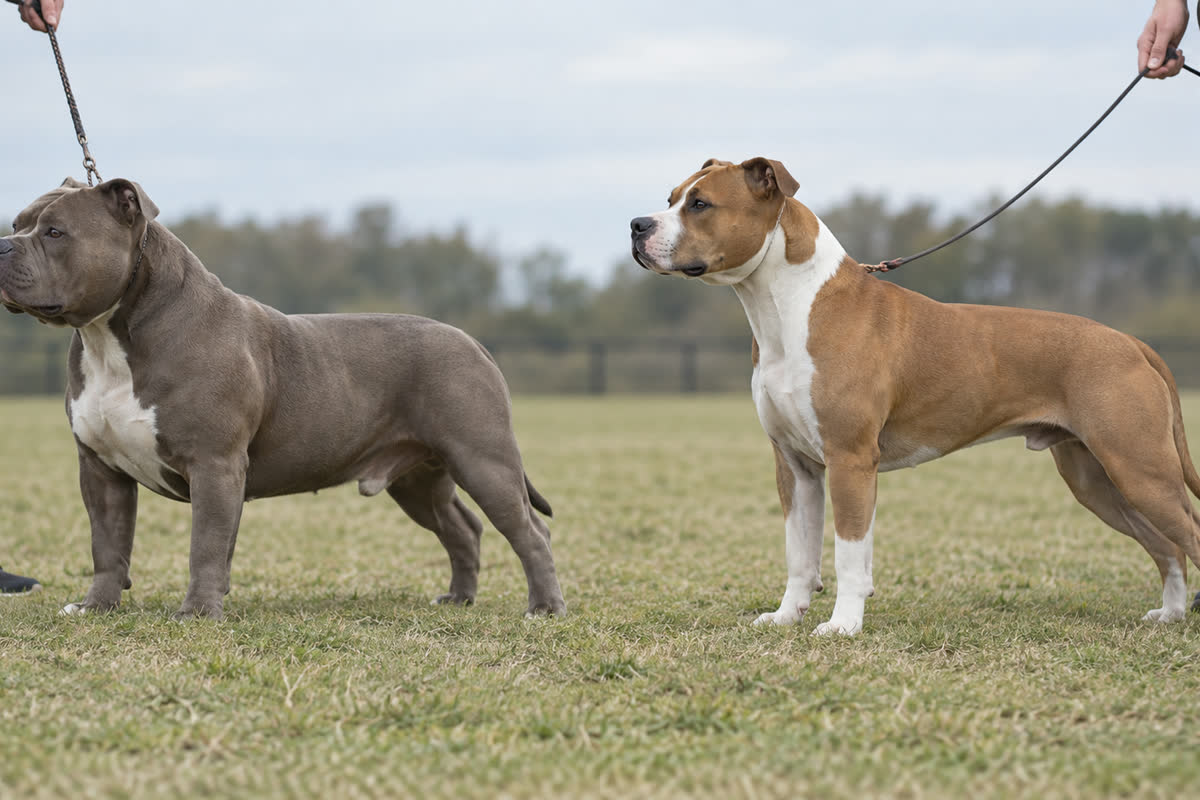
The AmStaff standard describes a dog that is “stocky, not long-legged or racy,” but still built for agility and grace, with a medium-length, well-defined muzzle. The American Bully standard calls for a noticeably broader, blockier head and a shorter, more compact muzzle, paired with heavier bone and more pronounced muscling through the chest and shoulders. Side by side, the AmStaff reads as an athletic terrier and the American Bully reads as a stockier, more heavily built companion dog, even at similar heights.
Ears, tail, coat and color rules
Both standards call for a short, close, glossy coat. The AKC standard allows cropped or uncropped ears on the AmStaff (uncropped preferred) and explicitly states the tail must not be docked; it also flags all-white, more-than-80%-white, black-and-tan and liver coloring as “not to be encouraged,” and a “Dudley” (flesh-colored) nose as a fault. The ABKC standard for the American Bully permits natural or cropped ears and states “all colors and patterns are permissible,” while the UKC’s version of the standard disqualifies merle coloring and blue eyes outright. That distinction matters in practice: a merle-colored dog marketed as a “rare” American Bully can be shown or registered under ABKC rules but disqualified under UKC’s.
Which one has the calmer temperament?
In practice, American Bullies are usually calmer and lower-drive than AmStaffs as companions — that’s a tendency, not a guarantee, since individual dogs, socialization, and line all vary more than breed averages suggest. Both standards describe stable, people-oriented dogs, but they’re written for different jobs. The AKC standard calls the AmStaff’s courage “proverbial” while emphasizing agility and gameness, and AmStaffs tend to run higher-energy and more sport-driven as a result of that working-terrier lineage. The ABKC standard for the American Bully explicitly states that “human or dog aggression, extreme shyness, or viciousness is very uncharacteristic of the breed” and lists it as highly undesirable, reflecting the breed’s development as a companion animal first. Temperament-testing data adds useful context but comes with a major caveat: as of January 2023, the American Temperament Test Society had run 770 AmStaffs (85.7% passed) and 960 American Pit Bull Terriers (87.6% passed), but only 6 American Bullies total. Six dogs is not a usable sample, so any “American Bully temperament pass rate” you see quoted from that dataset should be ignored.
What health problems should owners of each breed test for?
The AmStaff has an actual parent-club testing protocol, including DNA testing for NCL-A and ALPP; the American Bully has none. This article is educational, not veterinary advice — talk to your vet about testing schedules and symptoms specific to your dog. The STCA’s recommended health testing covers hip evaluation (OFA from age 2, or PennHIP from 16 weeks), a cardiac exam from a cardiologist starting at age 1, annual thyroid panels, and that NCL-A/ALPP DNA testing, with elbow and eye exams as optional extras. NCL-A (neuronal ceroid lipofuscinosis) is a recessive neurological disease that typically shows up between 3 and 6 years of age, starting with impaired balance and progressing from there; OFA describes it as “quite common” in AmStaffs and American Pit Bull Terriers. ALPP is linked to laryngeal paralysis. The STCA’s breeding guidance is straightforward: don’t pair two carriers, and don’t breed affected dogs.
The American Bully has no equivalent parent-club testing protocol, since the ABKC standard doesn’t specify one. That puts more of the burden on the buyer — ask any breeder directly for OFA or PennHIP hip and elbow results and any DNA panel results they’ve run, rather than assuming a health guarantee covers it. Both breeds are also watched for general skin allergies and demodectic mange, though reliable population-level prevalence numbers for either breed are hard to verify, so treat any specific percentage you see quoted online with caution unless it’s sourced to a primary registry or veterinary study.
Are either of them restricted by breed laws?
The clearest current legal restriction affecting either breed is the UK’s XL Bully ban (checked September 25, 2026), which applies to England and Wales — Scotland and Northern Ireland have separate rules, so check those directly if you’re there. Selling or breeding an XL Bully has been illegal there since December 31, 2023, and owning one without a Certificate of Exemption has been illegal since February 1, 2024. Exemption applications are now closed, and new exemptions are only granted by court order. From November 1, 2026, a new rule prevents children under 12 from being left unsupervised with an exempted XL Bully in private spaces. The ban’s definition starts at 20 inches (51 cm) at the shoulder for males and 19 inches (48 cm) for females, combined with a physical-conformation guide. Enforcement is based on a dog’s measured size and build, not its paperwork or breed name. This article won’t state whether a specific dog is or isn’t covered by the ban; that’s determined case by case against the official definition. More broadly, breed-specific legislation in other countries and municipalities often targets “pit bull type” dogs by appearance rather than registered breed, and that can sweep in AmStaffs as well as Bullies — always check the specific wording of local law rather than assuming a breed name exempts you.
How do you tell an AmStaff from an American Bully in person?
- Leg length vs. body: the AmStaff carries proportionally longer legs under an athletic frame; the American Bully sits lower and more compact relative to its body length.
- Head breadth: the American Bully’s head is visibly broader and blockier; the AmStaff’s head is more refined and terrier-like.
- Muzzle length: the AmStaff has a medium, well-proportioned muzzle; the American Bully’s muzzle is shorter and more compact.
- Overall athleticism: the AmStaff moves like a working terrier — light on its feet; the American Bully carries visibly heavier muscle mass and a slower, more deliberate gait.
- Ears and tail won’t help you: both allow cropped or natural ears, and neither allows a docked tail.
Which breed fits your home?
If you want a dog for structured sport, obedience work, or AKC conformation showing, the AmStaff’s single standard and long AKC show history make it the more straightforward path. Its higher energy level also suits an owner who wants an active daily routine. If you want a lower-drive companion dog and don’t need AKC papers, the American Bully’s calmer standard temperament and range of size varieties — from Pocket up to XL — give you more flexibility to match a dog to your living space. That’s as long as you’re comfortable that the breed sits outside AKC recognition. Registry goals matter here too: if AKC pedigree, shows, or specific registry-linked events are the plan, only the AmStaff qualifies. It’s worth reading the American Bully kennel club list to see exactly which organizations do register Bullies before you buy. Neither breed has a verified, current price figure worth publishing here — costs vary substantially by breeder, bloodline, and country, so treat any specific number you see quoted online with the same caution you’d apply to an unverified health statistic.
Frequently Asked Questions
Can you register an American Bully as an AmStaff?
No. They are separate breeds under separate standards. An American Bully cannot be registered with the AKC as an American Staffordshire Terrier regardless of its pedigree, and doing so would misrepresent the dog’s actual breed.
Do AmStaffs and American Bullies get along with other dogs?
Individual temperament, socialization, and training matter far more than breed here. Both standards call for stable, non-aggressive dogs, but any dog — including both of these breeds — should be introduced to unfamiliar dogs gradually and supervised, especially early in a relationship.
Can an AmStaff and an American Bully be bred together?
Physically, yes, but the resulting puppies would not be registrable as purebred AmStaffs under AKC rules, since the AKC only registers dogs from two AKC-registered AmStaff parents. Check the specific registry’s rules before planning any cross-breeding, since requirements differ between the AKC, ABKC and UKC.
Conclusion
The American Bully and the American Staffordshire Terrier share ancestry but not a rulebook: the AmStaff is a 1936 AKC breed built for agility and terrier drive, while the American Bully is a companion breed developed in the 1990s and registered since 2004 (ABKC) and 2013 (UKC), with four size varieties and no AKC recognition. The clearest practical differences are the height standards, the registry-specific color and testing rules, and — if you’re in England or Wales — the legal exposure that only applies to dogs meeting the XL Bully’s physical definition. If you’re still deciding between a Bully variety, revisit the size-class breakdown above, and if a specific bloodline or breeder is on your shortlist, check its reputation before you check its paperwork.