
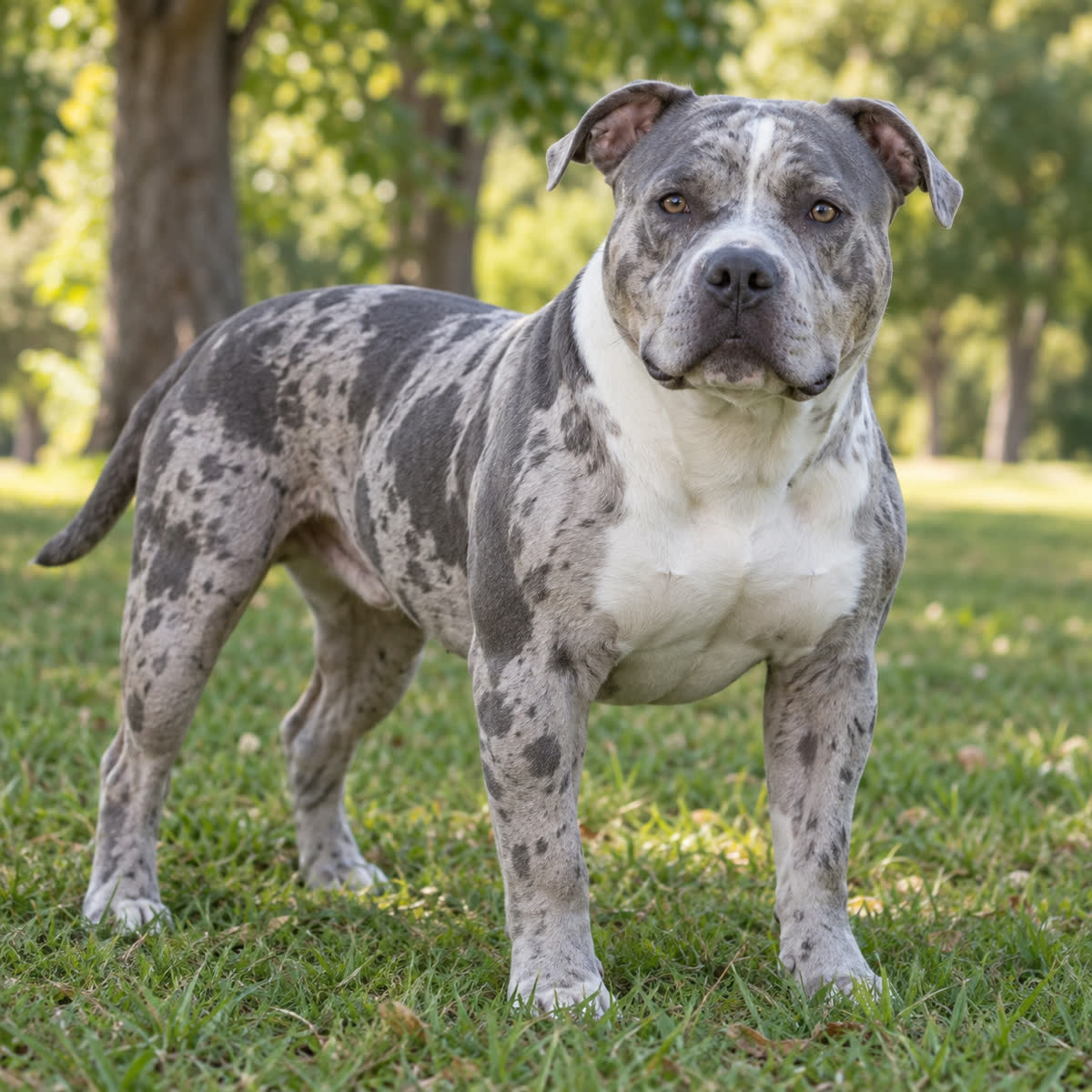
The merle American Bully carries a coat pattern that one registry welcomes and another disqualifies outright. Merle comes from a single gene: the American Bully Kennel Club (ABKC) permits it and the United Kennel Club (UKC) does not. The real danger only shows up when two merles are bred together.
What makes an American Bully merle?
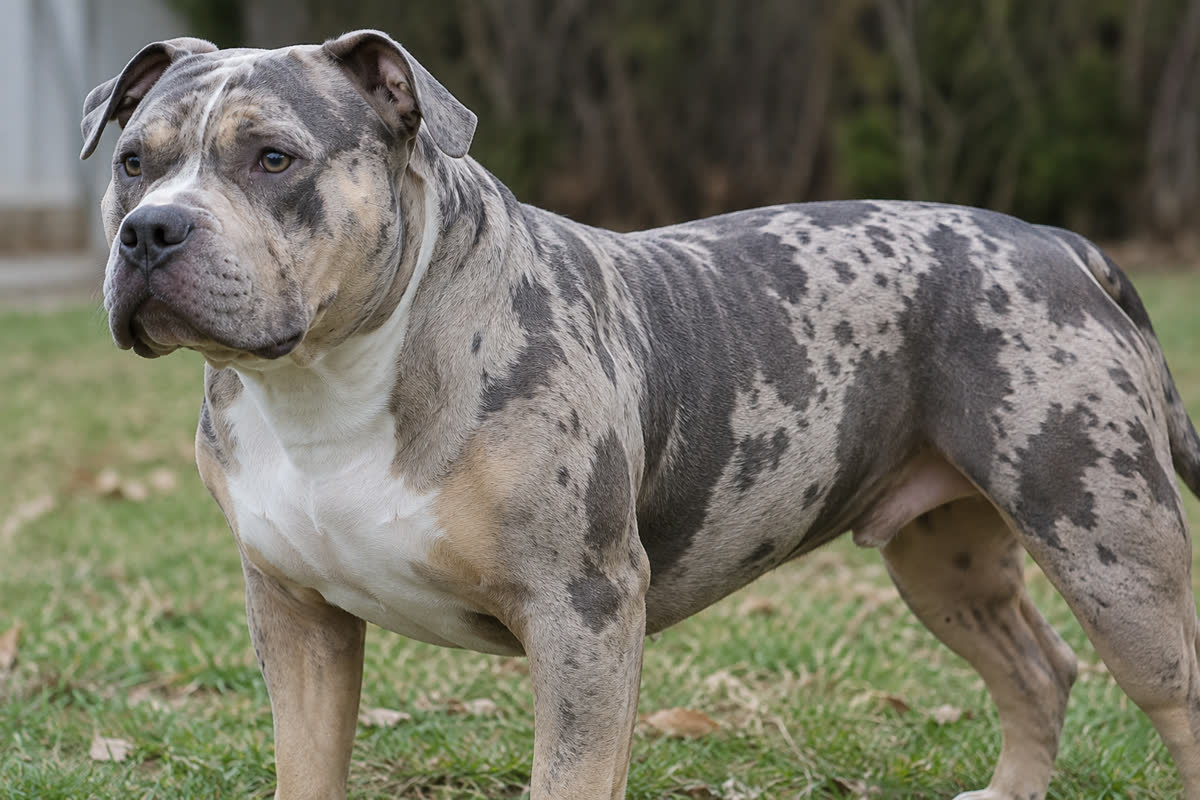
Merle is a coat pattern, not a color, caused by a single gene mutation — a SINE (short interspersed element) inserted into the PMEL (SILV) gene — that dilutes patches of the base coat while leaving the rest solid, producing a mottled or marbled look. It can appear in every American Bully size class, from Pocket to XL — merle is a pattern layered on top of a dog’s base color, not a variant tied to any one size.
How merle looks on a Bully
A merle Bully shows irregular patches of diluted pigment scattered across a darker base coat. A blue merle has grey-blue patches over black; a chocolate or red merle shows lighter tan or liver patches over a brown base. Eyes are often affected too — marbled or “cracked” irises, partial heterochromia, or one blue eye and one brown eye are common in merle dogs. The same gene disrupts pigment in the eye as well as the coat.
Merle vs brindle vs tri-color
These three get confused constantly, and they aren’t the same thing. Brindle is a striping pattern — dark stripes over a lighter base coat — and it’s a separate topic covered in full on this guide to brindle pitbulls. Tri-color comes from the agouti locus and produces tan points (eyebrows, cheeks, chest, legs) on a two-color base. The genetics of that pattern are covered on this guide to tri-color Bullies. Merle can sit on top of either a brindle or a tri-color base — they’re independent genes, not competing categories.
Does the ABKC or UKC accept merle American Bullies?
The ABKC allows merle; the UKC disqualifies it — and the two standards diverge sharply enough that a dog acceptable under one is unshowable under the other. Both standards below were checked directly as of September 25, 2026. The ABKC’s American Bully standard states under Color and Pattern that “all colors and patterns are permissible.” The same standard makes an explicit exception for merle on eye color: “blue eyes, lack of pigment around the eyes are undesirable with the exception of the merle/blotched coat pattern.” Mismatched eye color is likewise excused “with the exception of the merle/blotched coat pattern.”
The UKC’s American Bully standard, revised January 1, 2025, takes the opposite position: “any color, color pattern, or combination of colors is acceptable, except for merle.” Merle appears directly in the UKC’s disqualifications list alongside albinism. That’s a conformation-standard disqualification — it means a merle Bully can’t be shown or scored under the UKC standard, not that the UKC refuses to register the dog at all.
Here’s the nuance no breeder blog connects: the ABKC permits merle as a pattern, but it also lists unilateral or bilateral deafness as a disqualification in its own right. That matters because deafness is exactly the risk that climbs sharply in double merles — so an ABKC-permitted pattern can still produce ABKC-disqualified puppies if it’s bred carelessly. For more on how ABKC standards compare across registries, see this rundown of American Bully registries.
How is merle inherited?
Merle is inherited as an incompletely dominant trait on a single gene, which means one copy is enough to produce the visible pattern. Two copies produce a much higher-risk “double merle” dog. Because it only takes one copy to show the pattern, breeding a merle to a non-merle is genetically safe from a double-merle standpoint, provided the non-merle parent has been DNA-tested clear (see cryptic merle below). The risk only appears when both parents carry the gene.
| Parent pairing | Expected litter outcome (average, varies per litter) |
|---|---|
| Non-merle × Non-merle | 0% merle |
| Merle × Non-merle | ~50% merle, 0% double merle |
| Merle × Merle | ~25% non-merle, ~50% merle, ~25% double merle |
What is cryptic merle?
Cryptic (or “phantom”) merle is a dog that carries a merle allele but shows little or no visible pattern. That’s exactly why “just look at the parents” fails as a screening method. Merle is caused by a SINE insertion in the PMEL gene, and the length of that insertion’s poly-A tail varies. Langevin et al. identified a range of alleles (Mc, Mc+, Ma, Ma+, M, Mh): the shorter ones — cryptic Mc and atypical Ma — produce little or no visible merle, and the longer ones (M, Mh) produce the classic and harlequin patterns. A dog carrying one of the shorter, less-visible alleles still carries the merle gene and can still pass it on, according to allele-length research published in PLOS One. In one study, mosaicism — where a dog carries more than one allele length in different cells — turned up in roughly 16.6% of dogs tested (30 of 181). A visually “clean” parent can still be a cryptic merle carrier, which is why researchers recommend allele-length DNA testing rather than a visual check before any breeding decision.
What health risks come with merle?
A single merle carries a small but real increase in hearing and eye risk; a double merle carries a much larger one. Merle dogs — heterozygous and homozygous alike — can show a wide range of hearing and eye abnormalities tied to the same pigment-related mutation.
Double merle: deafness and eye defects
The numbers below come from BAER (brainstem auditory evoked response) hearing tests on 153 merle dogs across multiple breeds, published in the Journal of Veterinary Internal Medicine. The study wasn’t American Bully-specific, but the underlying genetics are the same gene in any breed that carries it.
| Single merle (Mm) | Double merle (MM) | |
|---|---|---|
| Copies of the merle allele | 1 | 2 |
| How it’s produced | One merle parent, one non-merle parent | Merle × merle pairing (~25% of the litter) |
| Deafness rate | 2.7% unilateral, 0.9% bilateral | 10% unilateral, 15% bilateral |
| Eye risk | Low but non-zero | Elevated; no published rate |
| ABKC show status | Pattern permitted; disqualified only if deaf | Pattern permitted; disqualified if deaf (about 1 in 4 in Strain 2009) |
| UKC show status | Disqualified (merle itself is a DQ) | Disqualified (merle itself is a DQ) |
The gap between 0.9% and 15% bilateral deafness is the entire argument against breeding merle to merle. It isn’t a small statistical bump — it’s a roughly 16-fold jump in the dog’s odds of losing hearing in both ears. Double merles are also at higher risk for eye defects tied to the same pigment disruption, though no peer-reviewed source gives a verified percentage for that risk specifically — it’s a real risk, just not one with a published number behind it.
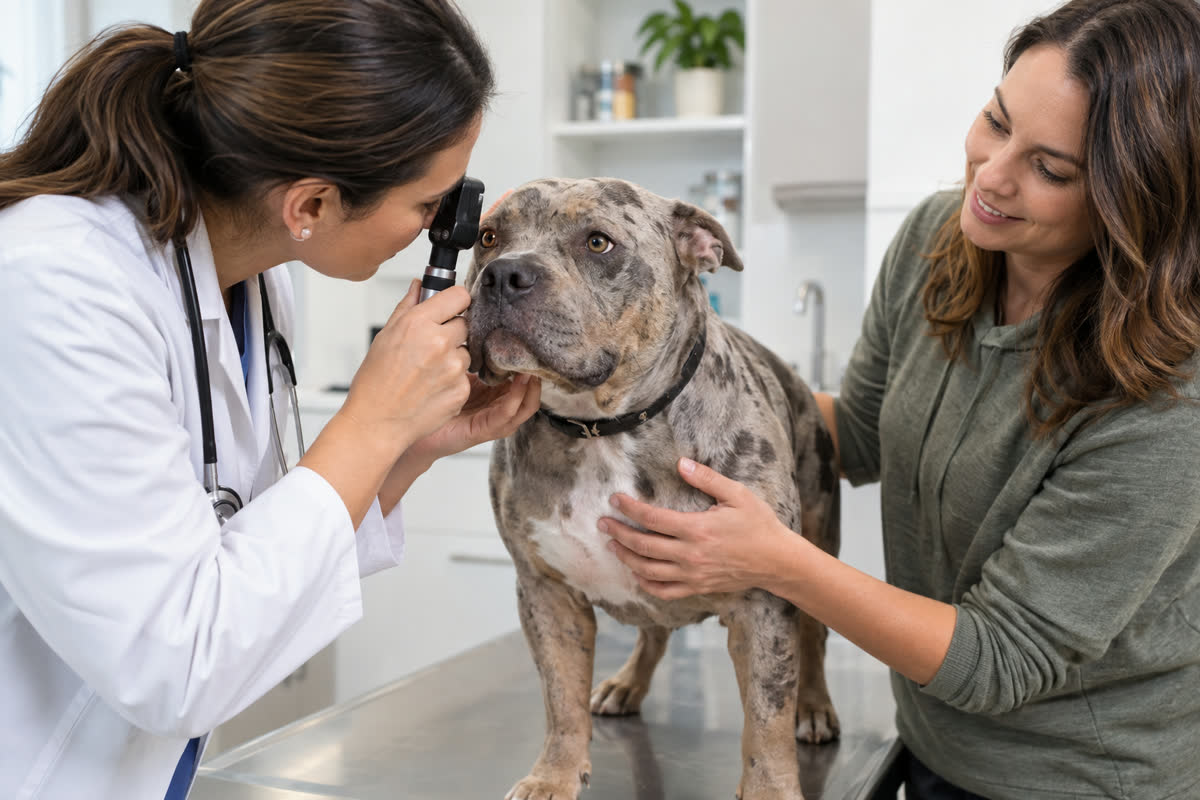
This section is educational, not veterinary advice. Have a vet BAER-test and eye-examine any merle puppy before you buy or breed it.
How to test a merle Bully before you buy or breed
Testing a merle Bully properly means going past a visual check, because cryptic merles can pass for non-merle by eye. A vet or breeder can confirm a dog’s real merle status with a DNA test that reports allele length, not just a merle/non-merle result. Work through this before any purchase or breeding decision:
- DNA test both parents with allele-length reporting — not just a positive/negative merle result, since cryptic and mosaic merles need the length data to be caught.
- BAER test the puppy, checking each ear individually rather than relying on a general “responds to sound” observation.
- Get an eye exam from a veterinary ophthalmologist, especially for any double merle or merle-to-merle litter.
- Never breed merle to merle. The ~25% double-merle rate in that pairing is the single highest-risk decision a breeder can make with this gene.
- Never breed a “non-merle” of unverified status to a known merle — a cryptic merle carrier looks clean and isn’t.
Frequently Asked Questions
Are merle Bullies purebred?
The merle pattern by itself doesn’t prove or disprove pedigree — it’s a coat gene, not a breed marker. The ABKC accepts merle under its own standard, but exactly how the gene entered the American Bully gene pool isn’t documented in any verifiable source. Treat pedigree claims on their own merits, not based on coat pattern.
Can a merle Bully have blue eyes?
Yes, and the ABKC standard specifically excuses merle dogs from the blue-eye and mismatched-eye faults that apply to every other coat pattern. The UKC standard takes the opposite stance, listing blue eyes (one or both) as a disqualification with no merle exception, on top of disqualifying merle itself.
Are merle Bullies more expensive?
Merle is often marketed at a premium, but there’s no verified, source-backed price data to cite a number against. Treat any specific price figure you see for a merle puppy as a seller’s claim, not a market fact.
Conclusion
Merle in the American Bully comes down to one gene, two registries with opposite rules, and one breeding decision that matters more than any other: never pair merle to merle. A single merle carries a small, real increase in hearing and eye risk; a double merle carries a risk roughly sixteen times higher for bilateral deafness alone. Before buying or breeding a merle Bully, get allele-length DNA testing on both parents, a per-ear BAER test on the puppy, and a veterinary eye exam. Confirm current registry rules directly with the ABKC or UKC, since standards can change after this article was checked.