
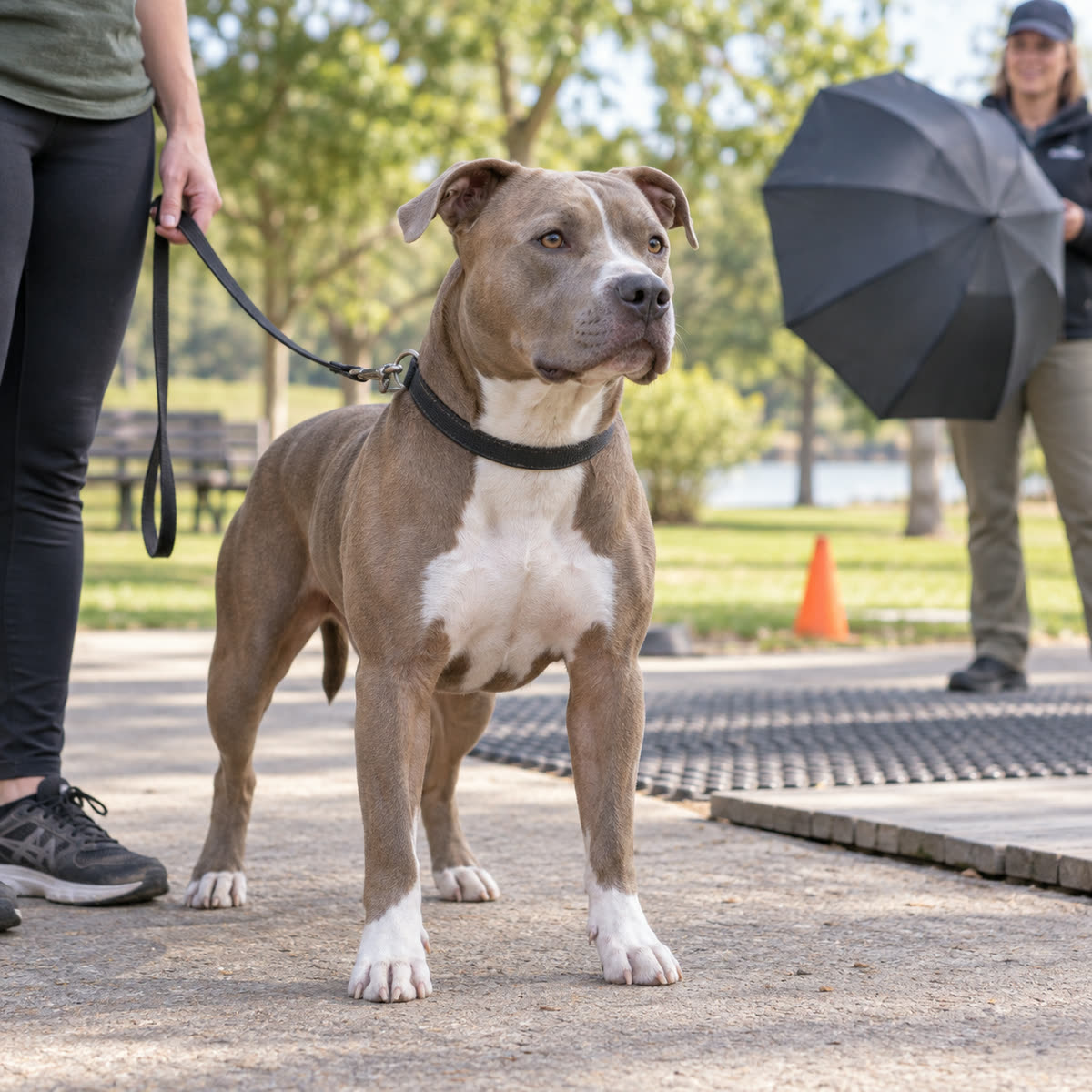
Pitbull temperament holds up better than most owners expect once you look past the slogans and at the actual numbers: the American Pit Bull Terrier passed the American Temperament Test Society’s evaluation at 87.6%, above the 84.0% all-breed average. That test measures how a dog reacts to strangers, noise, and surprise — not how it reacts to other dogs, which is where this breed’s real management issue sits. And breed itself turns out to explain only a small share of how any individual dog actually behaves.
What does the ATTS temperament test actually measure?
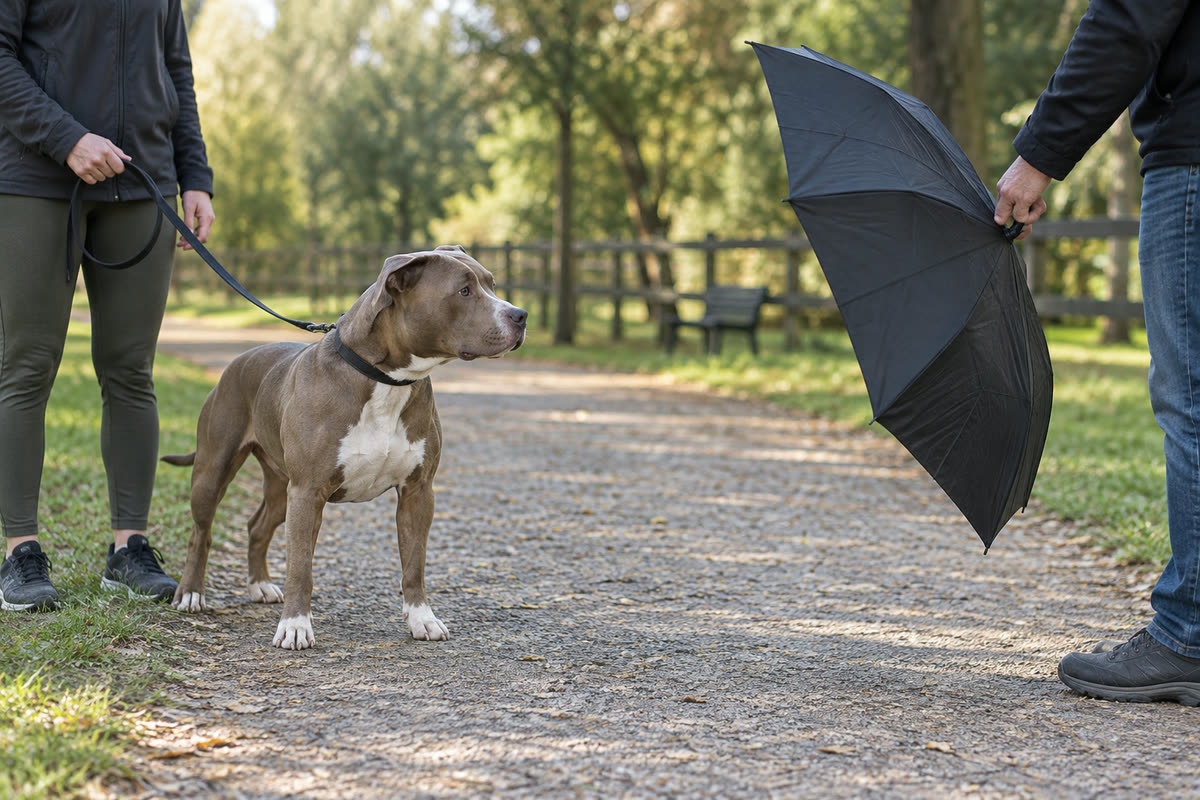
The ATTS test simulates a casual walk through a park or neighborhood, and it runs 10 subtests grouped into five categories: reactions to strangers (neutral and friendly), auditory stimuli (a hidden noise, gunshots), a visual surprise (an opened umbrella), unusual footing (plastic and wire surfaces), and self-protective or aggressive responses to a non-threatening, a threatening, and finally a “weird stranger.” A dog must be at least 18 months old to sit the test, it stays on a loose six-foot lead for 8 to 12 minutes, and the handler isn’t allowed to talk to, command, or correct the dog during the run. Three evaluators watch every dog, and a fail requires a zero score on any single subtest from at least two of the three. Failure means unprovoked aggression, panic without recovery, or strong avoidance.
What the test does not do is put the dog in front of another dog. Every score below is a measure of how a pitbull-type dog handles people, noise, and an unfamiliar environment — nothing more.
The dog in this ATTS demonstration is a Belgian Tervuren, not a pit bull-type dog — it’s included here because it’s the clearest available walkthrough of how the test itself runs, subtest by subtest.
How did pit bull-type breeds score on the ATTS test?
Pit bull-type breeds scored at or above the 84.0% all-breed average: the American Pit Bull Terrier passed at 87.6%, the American Staffordshire Terrier at 85.7%, and the Staffordshire Bull Terrier at 91.9%. The table below covers these breeds plus familiar comparison breeds and the all-breed total, using the American Temperament Test Society’s cumulative breed statistics as of January 2023.
| Breed | Dogs tested | Passed | Pass % |
|---|---|---|---|
| American Pit Bull Terrier | 960 | 841 | 87.6% |
| American Staffordshire Terrier | 770 | 660 | 85.7% |
| Staffordshire Bull Terrier | 160 | 147 | 91.9% |
| American Bulldog | 221 | 193 | 87.3% |
| Labrador Retriever | 872 | 806 | 92.4% |
| German Shepherd Dog | 3,500 | 2,999 | 85.7% |
| Chihuahua | 48 | 33 | 68.8% |
| All breeds (total) | 36,333 | 30,537 | 84.0% |
Source: American Temperament Test Society, breed statistics as of January 2023.
ATTS is explicit about what this number can and can’t tell you: “the pass-fail rate is not a measure of a breed’s aggression, but rather of each dog’s ability to interact with humans, human situations, and the environment.” The registered core of the type is the American Pit Bull Terrier, and the wider group of pit bull-type breeds people usually mean — including the American Staffordshire Terrier and Staffordshire Bull Terrier — is covered in our guide to the types of pitbulls.
Why a pass rate can’t prove a breed safe or dangerous
These numbers come with real limits. Owners choose to enter their own dogs, so the sample is self-selected rather than random. Breed is whatever the owner enters on the form, not a verified pedigree. Every dog tested is an adult, so the data says nothing about puppies or adolescents. Some breed samples are small — 160 Staffordshire Bull Terriers, 88 Bull Terriers — which makes their pass rates less stable than the larger samples. And the table is cumulative data last updated in January 2023, not a live snapshot. ATTS itself says comparing scores between dogs isn’t a good idea, and that logic extends to comparing scores between breeds.
What does the breed standard say a pitbull’s temperament should be?
The United Kennel Club’s American Pit Bull Terrier standard, revised May 1, 2017, describes the breed’s essential character as “strength, confidence, and zest for life.” It states that APBTs “make excellent family companions and have always been noted for their love of children.” The standard treats aggression toward people as a serious fault: “aggressive behavior toward humans is uncharacteristic of the breed and highly undesirable,” and viciousness is grounds for disqualification. That “love of children” line describes the breed’s ideal — not a guarantee about any dog carrying the label.
Are pitbulls good with other dogs?
Often not reliably, and this is the real management issue with the breed — not behavior toward people. The UKC standard says it plainly: “because most APBTs exhibit some level of dog aggression and because of its powerful physique, the APBT requires an owner who will carefully socialize and obedience train the dog.” That lines up with the C-BARQ survey data from Duffy, Hsu and Serpell: more than 20% of Pit Bull Terriers were reported by their own owners as showing serious aggression toward unfamiliar dogs, a rate the study found among only a handful of breeds.
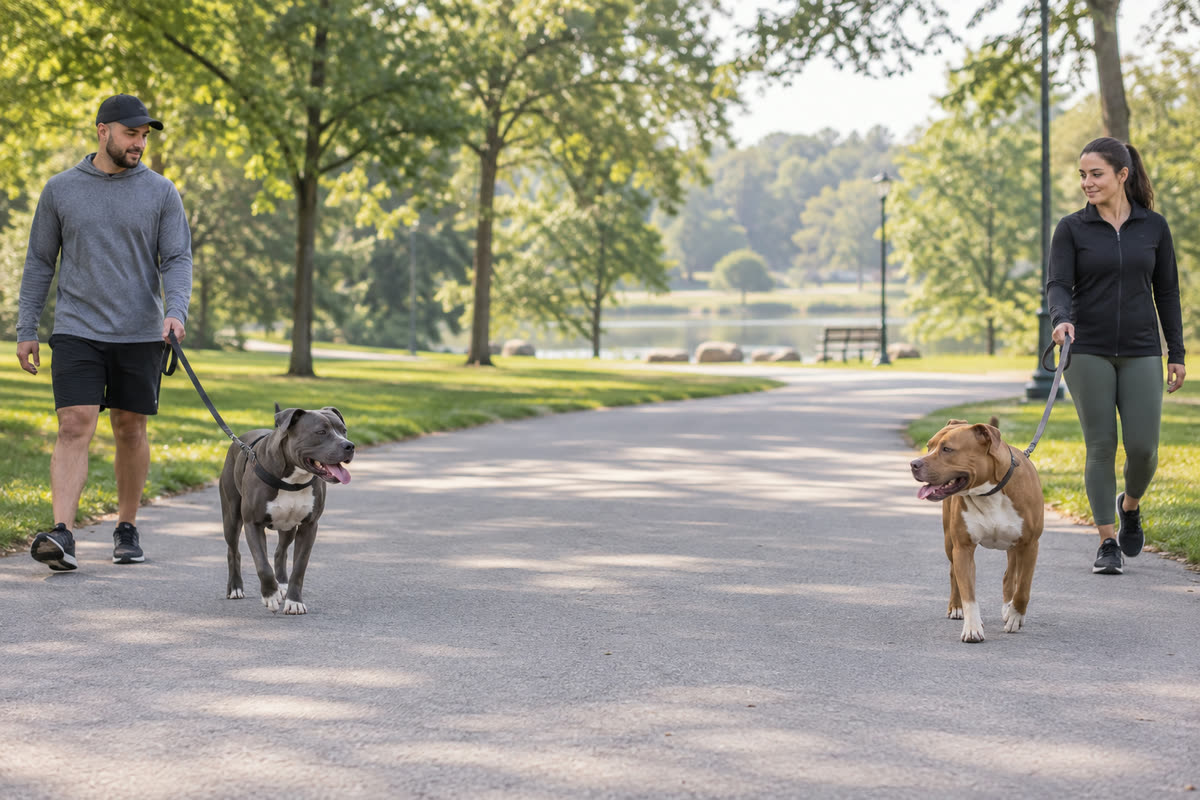
In practice, that means treating dog-to-dog introductions as the priority, not an afterthought. Introduce new dogs on neutral ground, on leash, before any off-leash time together. Watch body language rather than assuming a wagging tail means comfort. Off-leash dog parks are a genuine risk for any dog with dog-directed reactivity, pitbull-type or not, and a multi-dog household needs a real management plan — separate feeding, supervised time together, and a way to break up tension before it escalates. Our step-by-step pitbull socialization guide covers how to build this from puppyhood or retrofit it into an adult dog’s routine.
Are pitbulls good with kids?
This section is educational, not veterinary or behavioral advice — a professional assessment is the right next step for any dog showing real aggression.
An individual, well-socialized pitbull can be an excellent family dog, and the UKC standard’s “love of children” line reflects a real breed ideal. But no dog is kid-safe because of its label, and pit bull-type dogs are no exception. Every interaction between a dog of any breed and a young child should be supervised, full stop — not because pitbulls are uniquely risky, but because no breed removes the need for supervision. Teach children to read a dog’s warning signs (a stiff body, a tucked tail, whale eye, lip licking) and to leave a dog alone while it’s eating, sleeping, or guarding a toy. If a dog of any breed shows sudden aggression toward a child or anyone else in the household, that’s a reason to involve a veterinarian or a certified dog behavior professional, not to wait it out.
How much does breed really predict a pitbull’s behavior?
Less than most people assume. Morrill et al.’s 2022 study in Science, which surveyed owners of 18,385 dogs and sequenced DNA from 2,155 of them, found that “breed offers little predictive value for individuals, explaining just 9% of variation in behavior.” For what the researchers call “agonistic threshold” — how easily a dog is provoked by frightening or uncomfortable stimuli — the study found breed was “almost uninformative.” The American Pit Bull Terrier and Staffordshire Bull Terrier were both included in the study’s dataset.
There’s a second problem underneath all of this: the “pit bull” label itself is unreliable. Olson and Levy’s 2015 study had 16 staff across four shelters assess 120 dogs, and staff correctly identified dogs with pit bull-heritage DNA as pit bulls only 33% to 75% of the time, depending on who was judging. Dogs with no pit bull-type DNA were still labeled pit bull-type anywhere from 0% to 48% of the time, depending on the staff member. As Julie Levy, DVM, PhD, of the University of Florida put it, “reliable inclusion or exclusion of dogs as ‘pit bulls’ is not possible, even by experts.” Put those two findings together and the takeaway is straightforward: breed labels, including “pit bull,” are a weak predictor of how any specific dog will behave. Judge the dog in front of you.
What shapes an individual pitbull’s temperament?
If breed only accounts for a small slice of behavior, the rest comes from elsewhere. Genetics still matter at the individual level — a responsible breeder selecting for stable, biddable temperaments produces different puppies than one who isn’t selecting for temperament at all. Early socialization, while the dog is still a puppy, shapes how a dog reads and responds to new people, dogs, sounds, and environments for the rest of its life. Consistent, reward-based training builds impulse control and predictability. And physical health plays a bigger role than most owners expect: pain or illness can change a dog’s behavior, including new irritability or reactivity. A dog that changes character quickly needs a veterinary visit before anything else, not just more training — see our guide to keeping your pitbull healthy for what to watch for. This is general education, not veterinary advice.
One distinction worth making clearly: the American Bully is a separate breed from the pit bull-type dogs covered here, with its own build, history, and temperament profile — see our guide to the different types of American Bully for that breed specifically.
Frequently Asked Questions
Do pit bulls make good guard dogs?
No, not by breed design. The UKC standard says the APBT “is not the best choice for a guard dog since they are extremely friendly, even with strangers.”
At what age can a pit bull be temperament tested?
The ATTS test requires a dog to be at least 18 months old, so results only reflect adult behavior, not puppy or adolescent temperament.
Can a pit bull fail the temperament test and retest?
Yes. A dog that fails can retest after five months, with a maximum of two attempts total, per ATTS’s own FAQ. ATTS suggests a $30 entry fee per dog, though host clubs may charge more.
Conclusion
The headline number is real: pit bull-type dogs pass the ATTS temperament test at or above the all-breed average, and the UKC standard describes a breed that’s meant to be friendly with people, not aggressive toward them. But that same evidence base is explicit about what it doesn’t cover — reactions to other dogs — and that’s exactly where the honest data on this breed points to real risk: elevated dog-directed aggression reported by owners themselves, on top of a breed label that even shelter professionals apply inconsistently. Treat any pitbull-type dog as an individual rather than a statistic. If you own one, prioritize structured socialization and careful dog-to-dog introductions over relying on a breed reputation in either direction, and get a veterinary or behavioral opinion the moment a dog’s temperament changes unexpectedly.