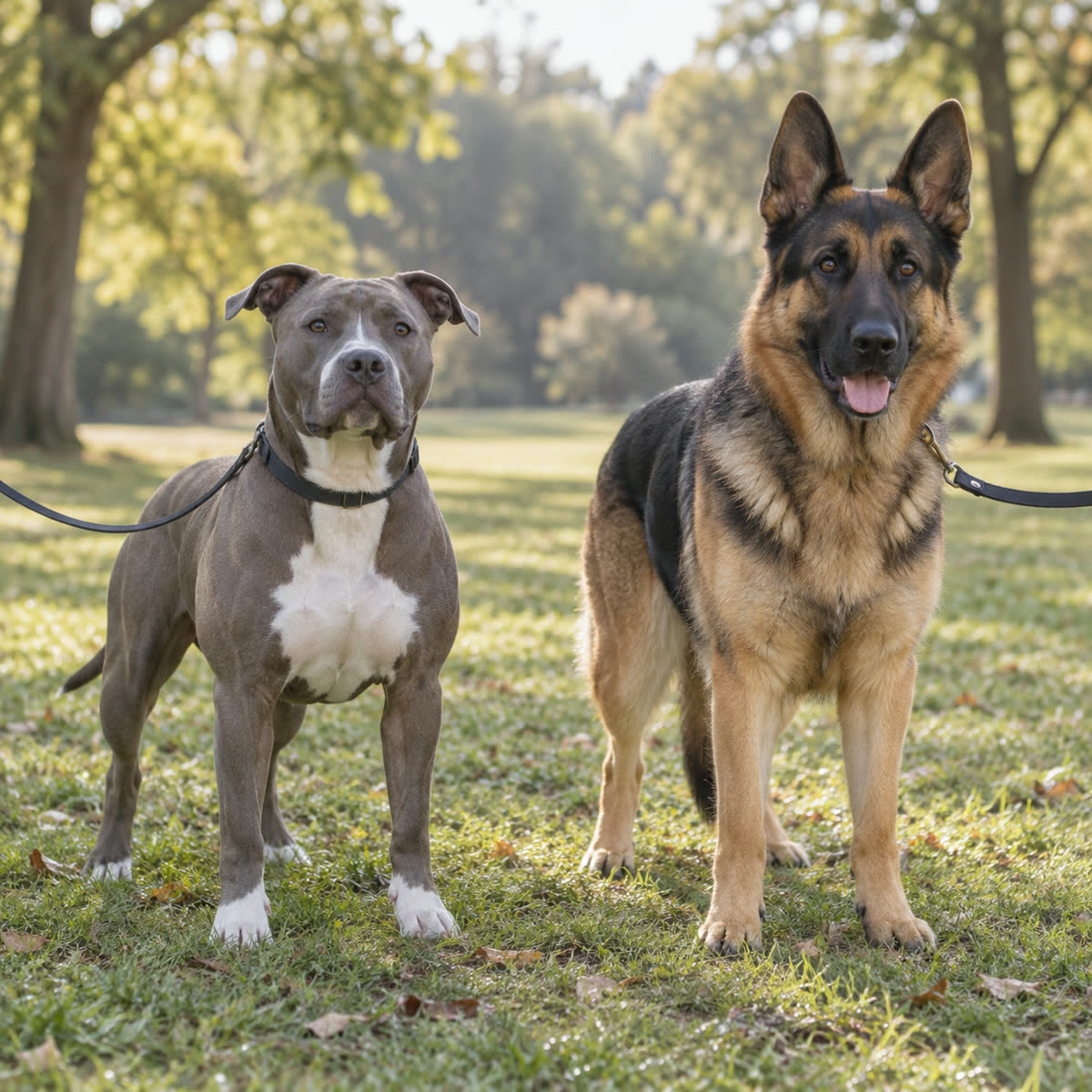
Pitbull vs German Shepherd comparisons usually turn into a size-and-strength argument, but the real decision comes down to two very different dogs: a compact, people-loving athlete built for close contact with humans, and a tall, aloof working dog bred to do a job. Picking between them means matching their coat, temperament, exercise needs and legal status to your home, your experience level, and the laws where you live.
How do the Pitbull and German Shepherd compare at a glance?
The table below uses the United Kennel Club’s American Pit Bull Terrier (APBT) standard and the American Kennel Club’s German Shepherd Dog standard, plus measured weight and longevity data from a large UK veterinary study, so the numbers below are sourced rather than guessed.
| Pit Bull (American Pit Bull Terrier) | German Shepherd Dog | |
|---|---|---|
| Registry | UKC (1898); not AKC-registered | AKC |
| Height | 17-21 in | 22-26 in at the withers |
| Weight | 30-60 lb | ~77-88 lb median adult bodyweight |
| Build | Medium-sized, solidly built, short-coated | Longer than tall, athletic working proportions |
| Coat & shedding | Short, single coat; low grooming | Dense double coat that sheds heavily; regular brushing needed, should never be shaved |
| With strangers | Typically friendly, even with strangers | Direct and fearless, with a natural aloofness rather than instant friendliness |
| With other dogs | Most individuals show some level of dog aggression and need careful socialization | Varies by individual; socialize and introduce new dogs gradually |
| Trainability / work style | Eager to please, high physical drive; originally a farm catch dog and companion | Bred as a companion, watchdog, herder and guardian; strong working and problem-solving drive |
| Lifespan | No breed-specific longevity study found; commonly cited estimate of about 12-14 years | Median longevity 10.3 years (IQR 8.0-12.1) |
| Key health watch-outs | Commonly reported skin allergies and hip dysplasia; ask a vet for a full picture | Hip and elbow dysplasia, otitis externa, osteoarthritis, and degenerative myelopathy in older dogs |
| Legal / housing friction | Banned by appearance in some countries (for example the UK’s Pit Bull Terrier type) regardless of paperwork | Not on the UK’s banned-types list (checked September 25, 2026); some insurers and landlords still restrict it |
Why “pitbull” needs defining before you compare
“Pitbull” is not a single breed — it is a type that includes the American Pit Bull Terrier, the American Staffordshire Terrier, the Staffordshire Bull Terrier, and in casual use, the American Bully. This guide compares the German Shepherd Dog specifically against the UKC’s American Pit Bull Terrier standard — the UKC was the first registry to recognize it, in 1898. If you want the full breakdown of the type, our guide to the types of pitbulls covers each one. The American Bully is its own separate breed with its own size classes rather than a pit bull variant — see the different American Bully types if that is what you’re actually comparing.
The distinction matters beyond terminology. A University of Florida College of Veterinary Medicine study (Olson et al., 2015) of 120 shelter dogs found DNA testing identified only 21% as pit bull-type, while shelter staff had labeled 52% of the same dogs that way — and dogs whose DNA showed pit bull-type ancestry were identified as pit bulls by shelter staff only 33-75% of the time. If you’re buying, adopting, insuring, or renting with a dog that might be labeled a pit bull, visual identification alone is not reliable — verify parentage or breed documentation before you assume a label is accurate.
How different are they in size and build?
The German Shepherd is the taller, heavier dog of the two by a wide margin. The AKC standard puts males at 24-26 inches and females at 22-24 inches at the withers, with a body proportioned longer than tall. A UK study of 12,146 German Shepherds measured median adult bodyweight at 40.1 kg (about 88 lb) for males and 34.8 kg (about 77 lb) for females. The American Pit Bull Terrier is far more compact: the UKC standard lists males at 18-21 inches and 35-60 lb, females at 17-20 inches and 30-50 lb, describing the breed as “medium-sized, solidly built” rather than tall. In practical terms, the GSD needs more vertical space to move and a larger dog bed and crate, while the pit bull’s lower mass and shorter coat make it easier to lift, bathe, and manage in tight spaces like an apartment or a car.
Which has the better temperament for your household?
With strangers and as a watchdog
The German Shepherd’s standard describes the breed as “direct and fearless, but not hostile,” with “a certain aloofness that does not lend itself to immediate and indiscriminate friendships” — a dog that sizes people up before it warms to them. The American Pit Bull Terrier runs the opposite way: the UKC standard states that “aggressive behavior toward humans is uncharacteristic of the breed and highly undesirable,” and specifically notes the APBT is “not the best choice for a guard dog since they are extremely friendly, even with strangers.” If you want a dog with natural reserve toward unfamiliar people, the GSD’s temperament is built for that. If you want a dog that greets everyone the same way, the pit bull’s is. For a watchdog, the German Shepherd is the clearer fit.
With other dogs and pets
This is where the pit bull needs the most deliberate management. The UKC standard notes that “most APBTs exhibit some level of dog aggression,” and because of the breed’s powerful physique, recommends an owner who will carefully socialize and obedience train the dog from an early age. Consistent, ongoing socialization — not a one-time puppy class — is the standard approach; our guide to socializing a pit bull walks through how to build that habit. German Shepherds vary more by individual and working line, but they still benefit from structured introductions to unfamiliar dogs — socialize and introduce new dogs gradually rather than assuming tolerance.
With children
Neither breed is automatically “safe” around kids by virtue of being a German Shepherd or a pit bull — individual temperament, training, and supervision matter more than breed labels for either dog. Both are physically strong enough to knock over a small child during normal play, so direct supervision with young kids applies regardless of which breed you choose.
Which is easier to train?
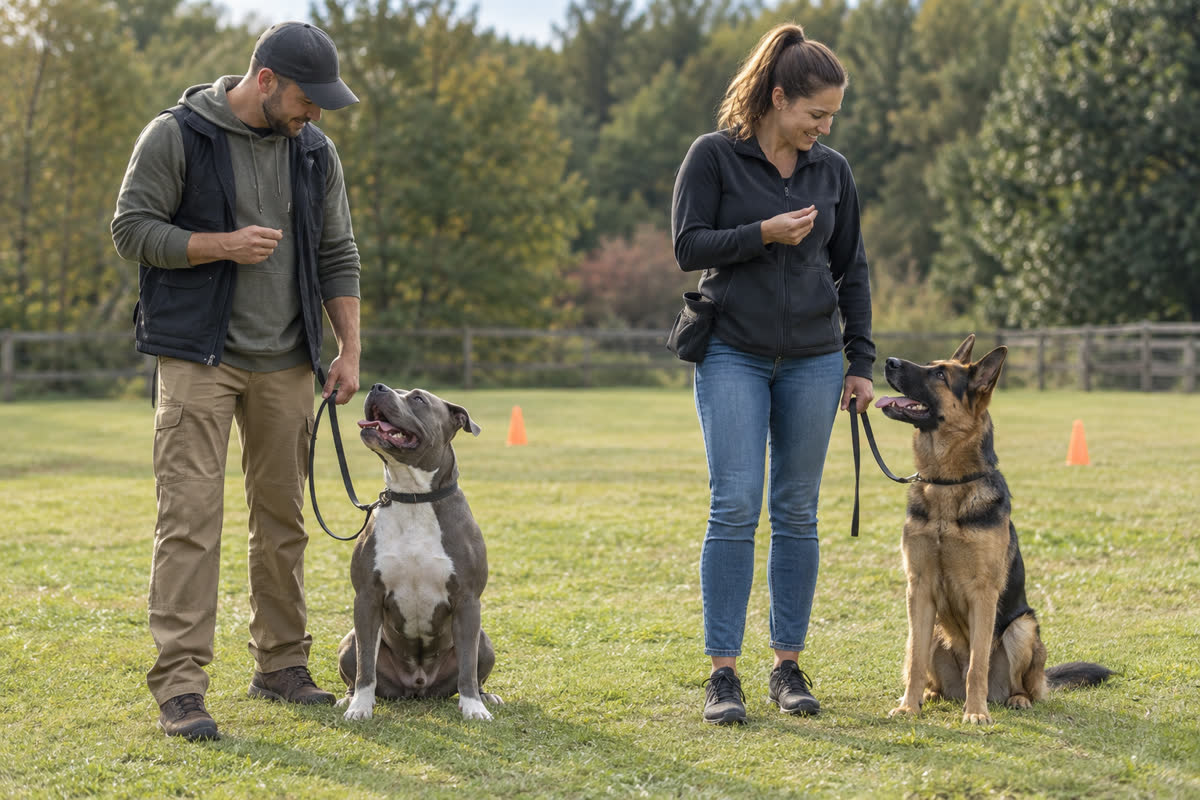
Neither is harder to teach; the German Shepherd needs more mental work, and the pit bull needs earlier impulse-control and dog-social work. The German Shepherd was bred as a working dog across multiple roles — “companion, watchdog, blind leader, herding dog, or guardian” — and that range shows up as a strong drive to learn tasks and solve problems — the same traits that make the breed widely used in police and service-dog work. That drive needs an outlet; a GSD without a job to do will often invent one you don’t want. The American Pit Bull Terrier is typically eager to please and responsive to training, but its combination of strength and dog-focused drive means impulse control and leash manners need early, consistent work — not because the breed is harder to teach, but because an untrained 50-lb dog with a strong pull is harder to manage than an untrained lapdog. Positive-reinforcement methods work well with both breeds; neither needs, or benefits from, heavy-handed correction-based training.
How much exercise and grooming does each need?
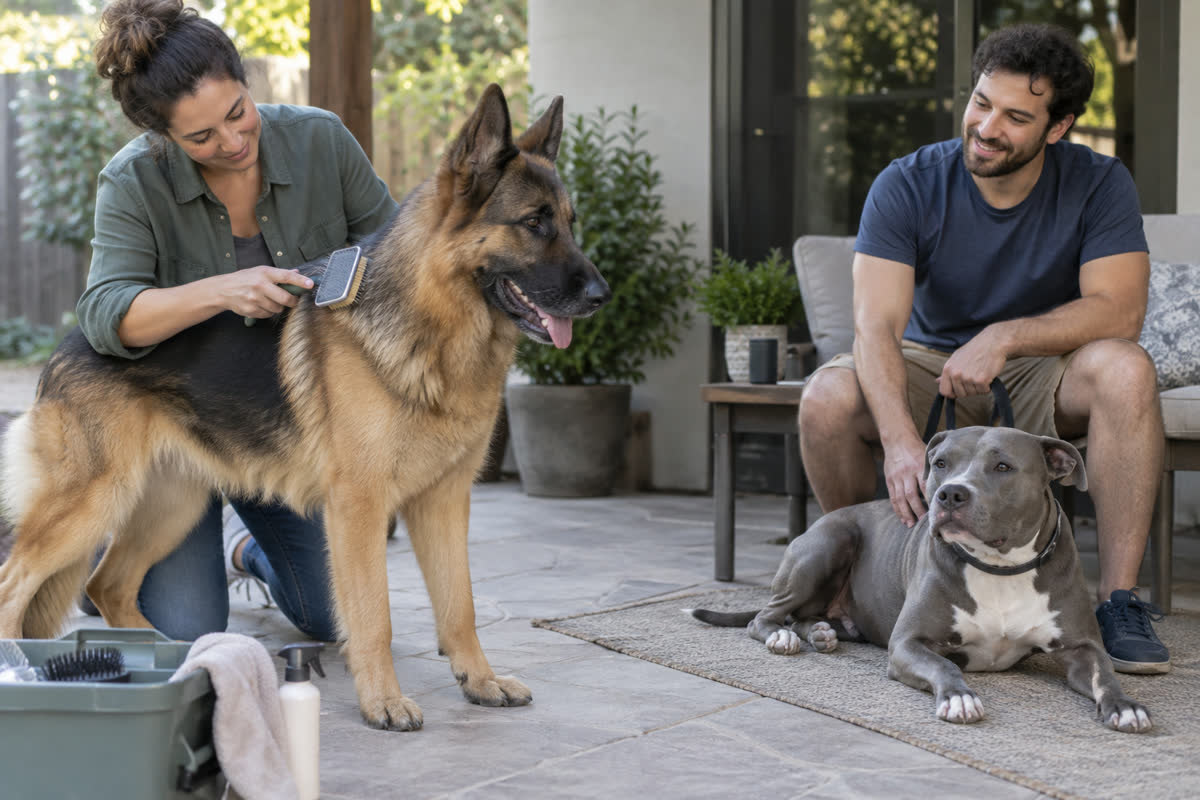
Grooming is the clearest split between the two. The German Shepherd has a dense double coat, and the AKC’s own advice is to brush regularly with a de-shedding tool — and never shave the coat. Expect fur on furniture and clothing as a normal part of GSD ownership. The pit bull’s short single coat sheds far less and needs only occasional brushing, making it the lower-maintenance choice for anyone who doesn’t want a vacuum on standby. Both breeds are athletic and were bred for sustained physical work, so both need daily exercise beyond a short walk — a GSD channels that energy well into structured training or herding-style activity, while a pit bull does well with active play, tug, and leashed runs.
Which breed has fewer health problems?
This section is educational, not veterinary advice — talk to a vet about any individual dog’s risk factors. No head-to-head study compares the two breeds directly: the German Shepherd’s risks are measured in detail by a large UK study, while pit bull-type risks are only commonly reported, not studied at the same scale. The German Shepherd has the more thoroughly documented health picture: a UK study of 12,146 GSDs found a median longevity of 10.3 years and identified the most common disorders as otitis externa (7.89%), osteoarthritis (5.54%), diarrhoea (5.24%), overweight or obesity (5.18%), and aggression recorded in clinical notes (4.76%, more common in males at 6.75% than females at 2.78%). The same study found musculoskeletal disorders and spinal cord disease among the leading causes of death — the breed is particularly vulnerable to degenerative myelopathy, a progressive, incurable spinal disease that usually appears between 4 and 14 years old; a DNA test for the SOD1 gene can identify clear, carrier, or at-risk dogs, though not every at-risk dog goes on to develop the disease. No comparable large-scale longevity study for the American Pit Bull Terrier specifically was found for this guide — treat any pit bull lifespan figure you see elsewhere as an estimate, not a measured statistic. Pit bull-type dogs are commonly reported to have skin allergies and hip dysplasia; our pit bull health tips guide covers what to watch for, but ask a vet for breed- and individual-specific guidance rather than relying on general reputation.
What legal and housing limits should you check first?
Checked September 25, 2026: the UK bans five dog types by appearance rather than breed papers, and the Pit Bull Terrier type is one of them — the government’s own guidance states plainly that “whether your dog is a banned type depends on what it looks like, rather than its breed or name.” The German Shepherd is not on that list. Outside the UK, breed-specific legislation, landlord restrictions, and homeowner’s insurance exclusions for pit bull-type dogs vary widely by country, state, city, and individual company or policy — some insurers and landlords also restrict German Shepherds, though less commonly. There is no single authoritative source covering every jurisdiction, so check your local ordinances, lease terms, and insurance policy before you commit to either breed, not after.
Pitbull or German Shepherd: which should you choose?
Use this as a starting checklist, not a final verdict — meet individual dogs before deciding.
Choose the German Shepherd if:
- You want a dog with natural reserve toward strangers and watchdog instincts
- You can commit to regular brushing and living with heavy shedding
- You want a dog that thrives on structured training, herding, or working-style activity
- You’ve confirmed your lease and insurance policy don’t restrict German Shepherds
Choose the Pit Bull if:
- You want a dog that is consistently friendly and affectionate with people
- Low-shedding, low-grooming upkeep matters to you
- You can commit to ongoing dog-to-dog socialization and management around other dogs
- You’ve confirmed local laws, your lease, and your insurance policy don’t restrict pit bull-type dogs
If you’re drawn to traits from both, the German Shepherd Pitbull mix guide covers that crossbreed in detail.
Frequently Asked Questions
Can a German Shepherd and a pit bull live together?
Yes, with a proper introduction and ongoing management. Introduce them on neutral ground, supervise early interactions closely, and don’t assume either dog’s temperament from breed reputation alone.
Which is better for a first-time owner?
Neither is a “beginner breed” in the low-effort sense — both need real training investment. Use the choose-if checklist above to match the breed to your lifestyle rather than your experience level alone.
Conclusion
The German Shepherd and the American Pit Bull Terrier solve different problems: one is a tall, aloof, heavy-shedding working dog that needs a job to stay balanced, the other a compact, people-friendly athlete that needs consistent socialization around other dogs. Neither is inherently “better” — the right choice depends on your space, your tolerance for shedding, your local laws, and whether you want a watchdog or a dog that treats every visitor like a friend. Before you commit to either, meet adult dogs of the breed in person rather than judging from puppies, check your local breed laws and lease or insurance terms, and ask any breeder or shelter for health screening results — OFA hip and elbow scores for a German Shepherd, and a general vet health check for a pit bull-type dog — before you bring one home.