
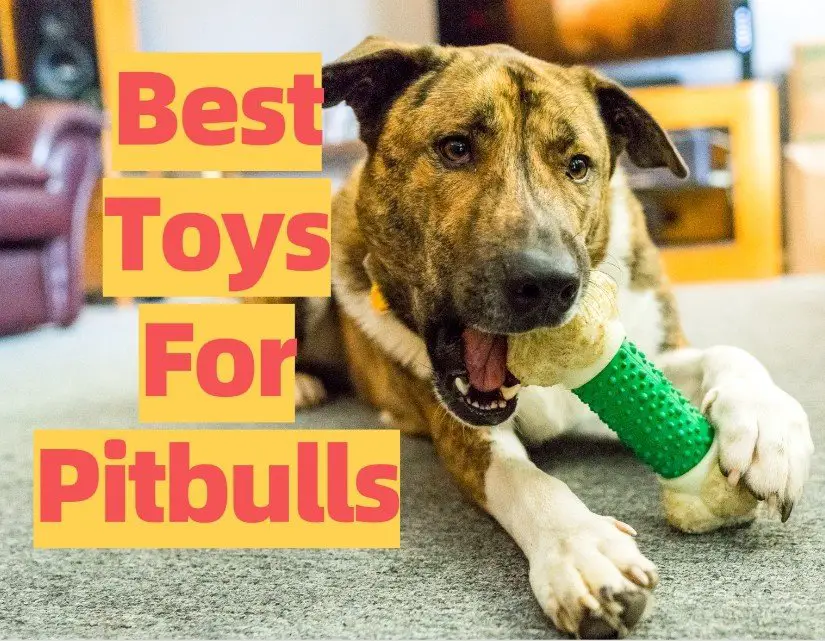
Pitbull-type dogs can be powerful chewers, intense tug players, and high-energy fetch partners. That does not mean they need the hardest toy on the shelf. The best toys for Pitbulls are the ones that match your dog’s size, chew style, play style, and supervision level.
This guide focuses on durable chew, tug, fetch, rope, and enrichment toys that fit the way many bully-breed dogs actually play. No toy is truly indestructible, so use these picks as starting points and replace anything that becomes cracked, sharp, frayed, or small enough to swallow.
Quick answer: For many Pitbulls, the safest toy setup is not one single “toughest” toy. Use a rotation: a rubber chew stick for chewing, a tug toy for supervised play, a KONG-style toy for food enrichment, a large rubber ball for fetch, and a rope toy only if your dog does not shred or swallow fibers.
Safety first: Avoid toys small enough to swallow, damaged toys with sharp edges, heavily frayed rope, and very hard chews that cannot be indented at all. If your dog swallows toy pieces, vomits, stops eating, has belly pain, or seems unusually tired, call your veterinarian.
Quick Picks: Best Toys for Pitbulls
- Best heavy-duty chew stick: Goughnuts Heavy Duty Dog Toy Stick — best for supervised chewing, carrying, and fetch-style play.
- Best nylon chew: Nylabone Power Chew Wishbone Chew Toy — best for steady gnawing and chew redirection.
- Best tug toy: Goughnuts Heavy Duty Tug Dog Toy — best for structured tug and owner-led play.
- Best classic enrichment: KONG Classic Dog Toy, Large — best for treat stuffing, kibble enrichment, and boredom reduction.
- Best fetch balls: Chew King Rubber Fetch Balls, 3-Inch 3-Pack — best for fetch, chase, and active play.
- Best rope option: Bmag Heavy Duty Dog Rope Toy with 5 Knots — best for supervised tug and short play sessions.
Best Toys for Pitbulls: Product Picks
These product picks are organized by use case: chewing, tug, enrichment, fetch, and supervised rope play. Choose based on how your dog actually plays, not only on which toy looks toughest.
Goughnuts Heavy Duty Dog Toy Stick
A heavy-duty rubber stick-style toy for dogs that need something tougher than plush or soft chews. It works best as a supervised chew, fetch, or carry toy for dogs that like stick shapes.
- Rubber stick shape is easy for many dogs to carry.
- More forgiving than very hard chews, but still needs supervision.
- Good choice for dogs that destroy plush toys quickly.
- Not a substitute for exercise, training, or active supervision.
Nylabone Power Chew Wishbone Chew Toy
A nylon chew for dogs that enjoy steady gnawing. It can help redirect chewing away from furniture or shoes, but hard nylon is not ideal for every dog.
- Wishbone shape gives dogs multiple chewing angles.
- Useful for chew-focused enrichment during supervised downtime.
- Pick the size that matches your dog’s weight and chew strength.
- Remove it if sharp ridges, splinters, or heavy wear develop.
Goughnuts Heavy Duty Tug Dog Toy
A rubber tug toy made for interactive play with larger dogs. It is best used for structured tug games, training rewards, and short play sessions with an owner.
- Designed for two-way tug play, not unattended chewing.
- Can help channel energy into structured play.
- Good for owner-dog engagement and training breaks.
- Stop the game if your dog gets too aroused or stops responding to cues.
KONG Classic Dog Toy, Large
A stuffable rubber enrichment toy for kibble, treats, or dog-safe fillings. For Pitbulls, the value is in using it as a boredom tool while still choosing the right size and checking the rubber often.
- Useful for food enrichment and slower treat sessions.
- Can be paired with measured kibble or lower-calorie fillings.
- Good option for toy rotation because it serves a different purpose than balls or tug toys.
- Inspect the opening and edges for cracks, tearing, or missing chunks.
Chew King Rubber Fetch Balls, 3-Inch 3-Pack
Rubber fetch balls for active, supervised play. They are a better fit than small tennis balls for many larger dogs, but ball size is still the main safety issue.
- Good for fetch sessions and high-energy play.
- Rubber is easier to rinse than fuzzy tennis-style balls.
- Multiple balls make rotation and replacement easier.
- Best used for interactive play, not constant chewing.
Bmag Heavy Duty Dog Rope Toy with 5 Knots
A heavy rope toy for supervised tug and short play sessions. Rope can be fun for strong dogs, but frayed strands and swallowed fibers are the risk to watch.
- Good for supervised tug and interactive play.
- Long rope shape helps keep hands farther from the dog’s mouth.
- Knots give the dog several grip points during play.
- Not safe for dogs that eat rope, strings, or fabric.
Affiliate disclosure: As an Amazon Associate, American Bully Daily may earn from qualifying purchases.
How to Choose the Right Toy for Your Pitbull
Start with size. A toy should be too large for your dog to swallow, but still comfortable enough to carry, chew, or chase. If your dog can fit the entire toy deep in their mouth, it may be too small.
Next, match the toy to the behavior you want to support. Chew toys are for chewing. Tug toys are for owner-led games. Balls are for fetch. Food-stuffable toys are for enrichment and slower treat time. Rope toys are for supervised tug, not for dogs that eat string.
Material Guide: Rubber vs Nylon vs Rope vs Balls
- Rubber toys: Good for many Pitbulls because they can offer durability with some give. Inspect rubber for cracks, missing chunks, or sticky worn areas.
- Nylon chews: Useful for steady gnawers, but they can be too hard for some dogs. Monitor teeth and gums, and avoid them if your dog has dental concerns.
- Rope toys: Best for supervised tug. Remove rope toys once they fray because swallowed fibers can cause problems.
- Rubber balls: Great for fetch if the size is right. Avoid small balls that can become choking hazards.
- Plush toys: Usually not ideal for destructive Pitbull chewers unless used briefly under close supervision.
How to Rotate Toys for Better Enrichment
Do not leave every toy out all the time. Rotate two or three toys every few days so they stay interesting. A simple rotation might be a rubber chew during calm time, a KONG-style enrichment toy after a walk, a tug toy for structured play, and a ball for fetch outside.
If your Pitbull chews from boredom, toys will help most when paired with exercise, training, and routine. For strong dogs that also pull hard on walks, combine toy enrichment with better walking gear and training structure. Our guide to Pitbull harness sizing and walking gear can help with that side of the routine.
What Toys Should Pitbulls Avoid?
Avoid toys that are too small, toys that break into sharp pieces, cooked bones, heavily damaged chews, and rope toys that your dog wants to eat instead of tug. Also be careful with very hard chews. If a chew feels harder than your dog’s teeth can safely handle, it may increase the risk of tooth damage.
For treat-stuffed toys, calories matter. If your dog gains weight easily, use measured kibble or lower-calorie fillings and adjust meals as needed. You can also compare food options in our guides to best dog food for Pitbulls and low-fat dog food options.
FAQ
Are there truly indestructible toys for Pitbulls?
No toy is truly indestructible for every Pitbull. Some toys are more durable than others, but a determined strong chewer can damage rubber, nylon, rope, or plush if given enough time and pressure.
That is why supervision matters. Use durable language, not guaranteed language, when choosing toys. Inspect toys after every serious chew session and replace them once they become cracked, sharp, frayed, or small enough to swallow.
For most Pitbull owners, the safer goal is not finding one impossible-to-destroy toy. The goal is matching the toy to the dog’s play style, using the correct size, and rotating toys before they become boring or damaged.
Which toy should I choose first for a heavy-chewing Pitbull?
If your dog mainly chews, start with a durable rubber chew like the Goughnuts Heavy Duty Dog Toy Stick or a nylon option like the Nylabone Power Chew Wishbone. Rubber is often a better first stop if you are worried about very hard chews, while nylon may suit dogs that like steady gnawing.
Watch how your dog uses the toy. If they calmly chew and carry it, that is different from trying to bite pieces off. If your dog immediately creates chunks, sharp ridges, or deep cuts, remove the toy and choose a different material or size.
For dogs with dental issues, previous tooth fractures, or extreme bite pressure, ask your veterinarian before using very hard chews. A toy that works for one strong chewer may be a poor fit for another.
Is the Goughnuts stick better than a Nylabone for Pitbulls?
Neither is automatically better. They solve different problems. The Goughnuts stick is a rubber toy that may suit dogs that like to carry, chew, and play with a little more flex. The Nylabone is a harder nylon chew for dogs that enjoy long gnawing sessions.
If your Pitbull bites down extremely hard, monitor both closely. Rubber can still be damaged, and nylon can be too hard for some dogs’ teeth. The best pick depends on whether your dog shaves, gnaws, carries, or tries to break pieces off.
When in doubt, start with supervised short sessions. Check the toy after 10–15 minutes instead of leaving it out all day.
Is a KONG Classic good for Pitbulls?
A KONG Classic can be useful for many Pitbulls because it gives them a job: licking, chewing lightly, and working for food. It is especially helpful for boredom, crate breaks, or calm time after exercise.
The important part is sizing and filling. Choose a size your dog cannot swallow or wedge too far into their mouth. Use measured kibble, dog-safe fillings, or lower-calorie options if your dog needs weight control.
Inspect the opening and edges regularly. If your dog is a powerful destroyer, you may need a tougher version or a different enrichment tool.
Are rope toys safe for Pitbulls?
Rope toys can be safe for supervised tug, but they are not a good fit for every Pitbull. The problem is not tug itself. The problem is fraying and swallowing strings or fibers.
If your dog tugs, releases, and leaves the rope alone after play, a heavy rope toy can be useful. If your dog shreds rope and eats the strands, skip rope toys and choose rubber tug or chew options instead.
Always put rope toys away after play. Throw them out once they become stringy, loose, or easy to pull apart.
What size ball is safest for Pitbulls?
Choose a ball large enough that your dog cannot swallow it or lodge it in the back of the throat. Many Pitbull-type dogs need larger rubber balls than the small balls used for smaller breeds.
Rubber fetch balls like the Chew King Rubber Fetch Balls can work well for supervised fetch, but no ball should become a full-time chew toy. Remove balls that crack, split, turn sticky, or start losing pieces.
If your dog tries to chew balls apart instead of chasing them, use ball play only during supervised fetch sessions and put the balls away afterward.
Can I leave chew toys with my Pitbull in the crate?
Only leave a toy in the crate if you already know your dog can use it safely. Test the toy during supervised sessions first. If your dog damages it quickly, do not leave it in the crate.
Food-stuffable rubber toys may be better crate options for some dogs than rope, plush, or hard chews, but it still depends on your dog. Use measured fillings and inspect the toy before and after crate time.
Do not leave rope toys, damaged toys, or small balls in the crate with a strong chewer. If your dog has a history of swallowing toy pieces, ask your veterinarian or trainer for safer enrichment options.
How often should I replace Pitbull chew toys?
Replace a toy as soon as it becomes unsafe, not after a set number of weeks. Warning signs include cracks, sharp edges, loose chunks, heavy fraying, missing pieces, exposed inner material, or a toy becoming small enough to swallow.
Strong chewers may need toy checks after every session. Softer chewers may get more time from the same toy, but every toy still needs inspection.
If a toy repeatedly fails quickly, switch material or play category. For example, a dog that destroys rope may do better with rubber tug, while a dog that ignores balls may need food enrichment instead.
How many toys should a Pitbull have?
Most Pitbulls do well with a small rotation instead of a huge pile. A practical setup is one chew toy, one enrichment toy, one tug toy, and one fetch toy. Add or remove toys based on what your dog actually uses safely.
Rotation keeps toys more interesting. Put some toys away and bring them back later so they feel new again. This can help reduce boredom-based chewing without constantly buying more toys.
If your dog also needs better diet support for treat-filled toys, see our guide to dog food for Pitbulls. For related strong-breed nutrition context, you may also find the American Bulldog nutrition guide useful.