
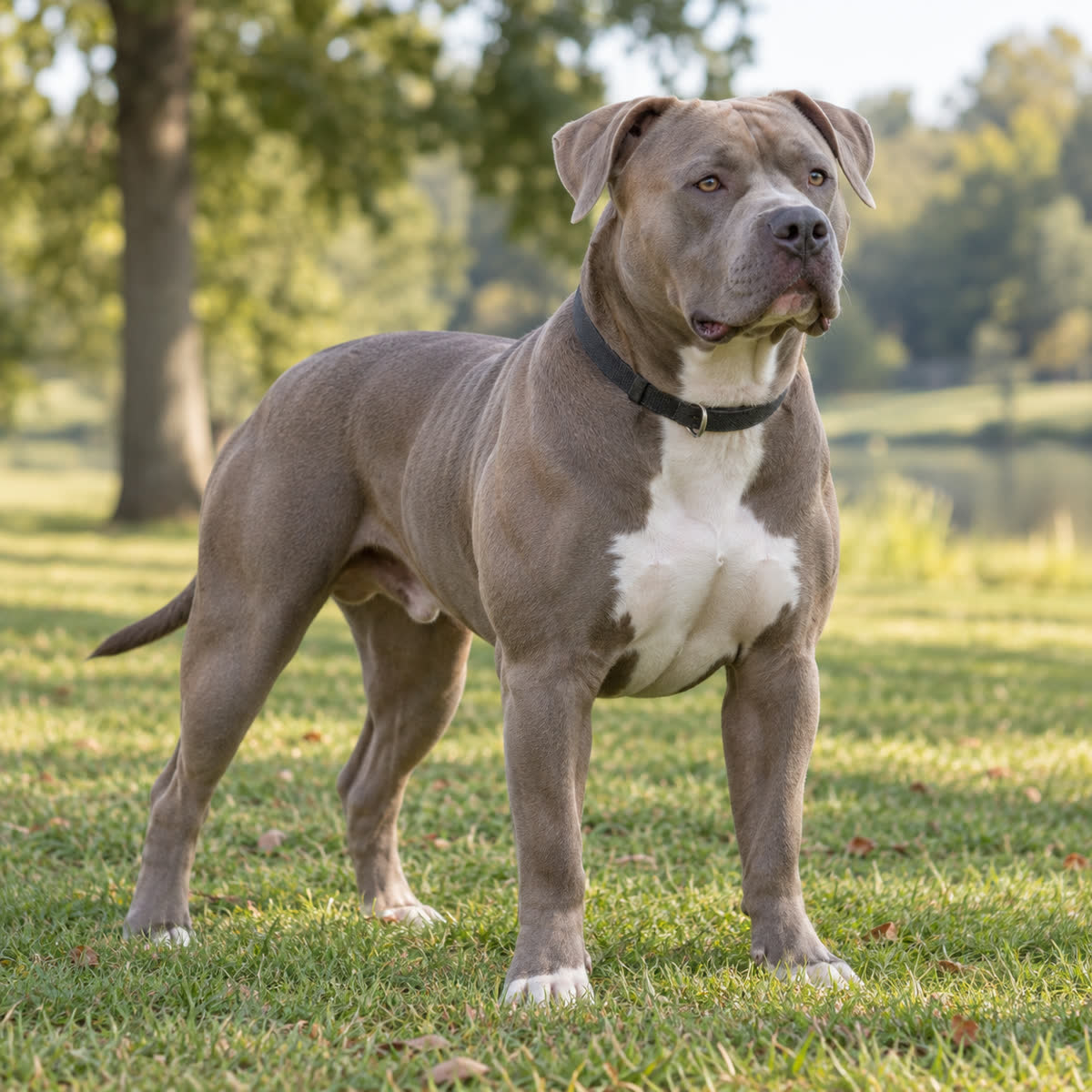
The XL American Bully is the tallest recognized size class of the American Bully, standing over 20 to 23 inches at the withers in males and over 19 to 22 inches in females, with no official weight set by either major registry. It carries the same build and breed type as every other American Bully size class — it’s simply taller. Before you buy or bring one home, you need to know how registries actually define “XL,” what it costs to keep a 100-plus-pound dog healthy, and whether the law where you live treats the breed differently.
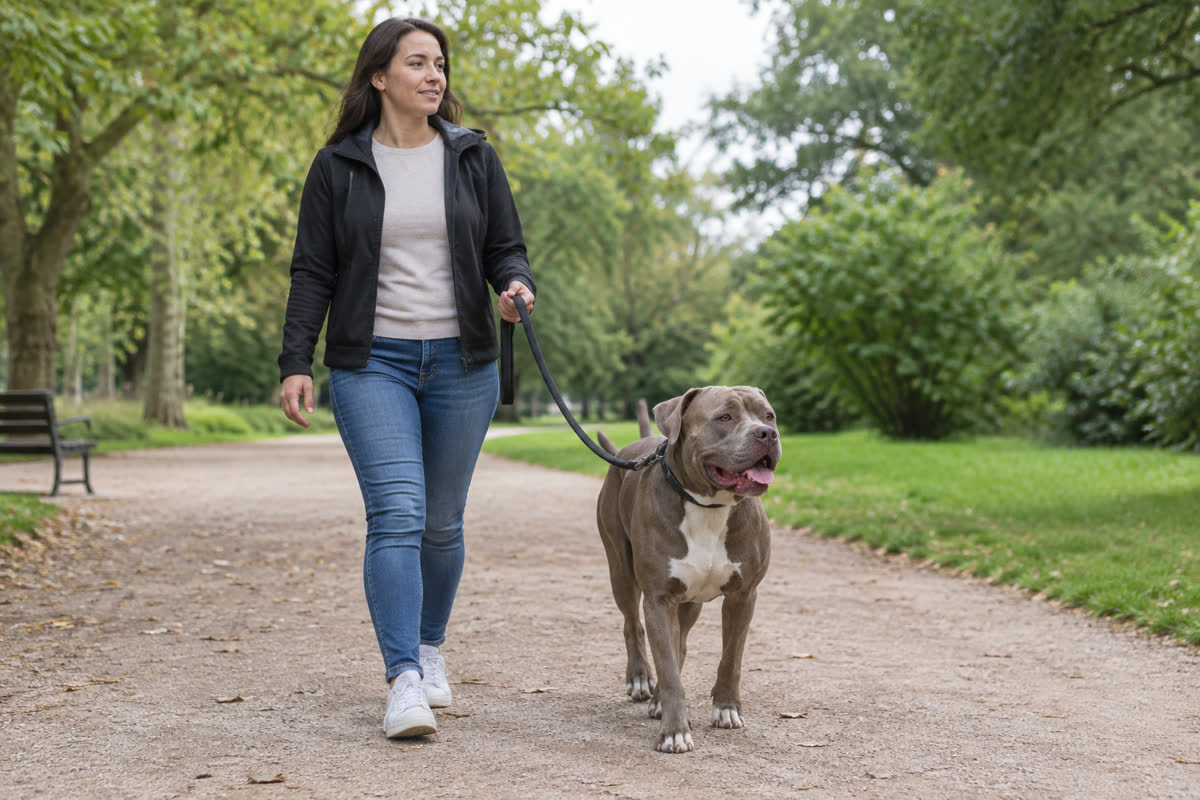
How big does an XL Bully get?
The XL Bully’s height is set by the American Bully Kennel Club (ABKC) breed standard and the United Kennel Club (UKC), and both agree on the same range: males stand over 20 inches (51 cm) up to 23 inches (57 cm) at the withers, and females stand over 19 inches (48 cm) up to 22 inches (54 cm). The withers is the ridge between the shoulder blades — the standard measuring point for any dog’s height, taken with the dog standing square on a flat surface.
Weight is a different story. Neither the ABKC nor the UKC sets a weight for the American Bully at any size. Adult XLs are commonly reported at around 80 to 150 lb depending on frame and conditioning, but treat that as an observed range, not a standard — no registry publishes one.
| Size class | Male height (at withers) | Female height (at withers) |
|---|---|---|
| Under 17 in | Under 16 in | |
| Standard / Classic | 17–20 in | 16–19 in |
| XL | Over 20–23 in | Over 19–22 in |
| “XXL” (not a registry class) | Unofficial label above XL | Unofficial label above XL |
The Classic Bully shares the Standard’s height range but is built with a lighter frame and less mass — an XL is taller than both, with the same heavy-muscled, bulky body type carried up in scale.
XL vs XXL: what’s the difference?
“XXL” is not a class either the ABKC or UKC recognizes — it’s a marketing label breeders apply to dogs taller or heavier than the XL standard allows. The UKC standard actually disqualifies “overly massive” American Bullies rather than rewarding them. If you’re comparing the two, read our full breakdown of the unofficial XXL Bully label before you pay a premium for the name.
How do the ABKC, UKC and UK law each define an XL?
Three different bodies define “XL,” and they’re answering three different questions: what a show judge should reward, what a registry will paper, and what a government will regulate. The ABKC and UKC define XL identically by height, but they split on color, and UK law uses a lower threshold based on physical traits rather than papers.
| Definition | Male height | Female height | Weight | Color rules | What it’s for |
|---|---|---|---|---|---|
| ABKC | Over 20–23 in | Over 19–22 in | None set | All colors and patterns permissible; blue eyes undesirable except in merle/blotched coats | Conformation showing and registration |
| UKC | Over 20–23 in | Over 19–22 in | None set | Merle and blue eyes disqualified | Conformation showing and registration |
| UK government (legal) | From 20 in | From 19 in | Not used | Not used — based on physical traits, not registration | Determining which dogs fall under the ban |
The gap between the ABKC and UKC standards on coat is worth noting. The current ABKC breed page lists all colors and patterns as permissible, while the UKC’s standard, revised January 1, 2025, disqualifies merle outright. If a seller tells you a merle XL is ABKC-registerable, ask to see current paperwork rather than taking their word for it.
The UK’s legal definition matters because it starts at the very bottom of the XL height range and is based on how a dog looks, not on its papers. That means it can catch crossbred or unregistered dogs that a registry would never classify as American Bully at all.
Where did the XL Bully come from?
The American Bully — and the XL within it — was developed in the 1980s and 1990s from the American Pit Bull Terrier foundation, with American Bulldog, English Bulldog and Olde English Bulldogge crossed in to build a heavier, more muscled companion dog. The ABKC recognized the breed in 2004, and the UKC followed on July 15, 2013. The American Kennel Club does not recognize the American Bully at any size. If you’re trying to place the XL relative to its ancestor breed, see how it actually compares to the American Pit Bull Terrier rather than assuming the two are interchangeable.
What is an XL Bully’s temperament like?
The XL Bully’s temperament, according to both registries, is built around friendliness, not aggression. The ABKC standard describes a dog that’s “great with kids, and extremely friendly with strangers, other dogs, and other animals,” and calls human or dog aggression, extreme shyness, or viciousness “very uncharacteristic of the breed” and “highly undesirable.” The UKC uses almost identical language, disqualifying “viciousness or extreme shyness” and calling aggression toward humans uncharacteristic. Aggressive behavior toward humans is an ABKC disqualification, not a trait the standard tolerates as “protectiveness.”
What that standard doesn’t tell you is what it’s like to live with 100-plus pounds of enthusiasm before that temperament is shaped by training. An XL Bully puppy needs early, consistent socialization and structured training. The size that makes an adult XL an imposing presence is exactly why an untrained one is harder to manage than a smaller dog with the same pushy streak. Build that foundation early with a program suited to the breed’s size and drive; our American Bully training guide covers where to start.
What health problems do XL Bullies have?
This section is educational and is not a substitute for veterinary advice. Talk to a vet about health screening and care specific to your dog.
An XL Bully’s size is itself a health factor: rapid growth and a heavy frame put more load on the joints than a mid-sized dog carries. A veterinarian-reviewed breed health overview lists the main joint and mobility risks as hip and elbow dysplasia, patellar luxation, cranial cruciate ligament injury, and osteoarthritis as the dog ages. It also flags brachycephalic obstructive airway syndrome (BOAS) in dogs with a shorter muzzle, plus heart, eye, dental, and skin or ear allergy issues that show up across the breed.
Rapid growth adds stress to developing joints. Veterinary research on hip dysplasia in large-breed puppies found that free-fed at-risk puppies developed the condition roughly two-thirds of the time, versus about one-third when portions were controlled. Overweight puppies were nearly twice as likely to develop it. Controlled feeding is one of the main risk factors an owner can influence.
How long do XL Bullies live?
You’ll see “10 to 13 years” repeated across breeder and marketplace pages as if it were settled, but the often-cited range is actually 8 to 13 years. A veterinarian-reviewed review of American Bully health found that breed-specific longevity data are limited — no study has measured the breed’s longevity in a large population. Treat 8 to 13 years as a reasonable planning window, not a guarantee, and weigh it against the joint and airway risks above when you’re budgeting for the dog’s later years.
What health tests should you ask a breeder for?
- Hip and elbow scores for both parents (OFA or an equivalent evaluation), not just a verbal assurance they’re “healthy”
- A cardiac check on both parents, given the breed’s reported heart issues
- An eye exam
- A chance to meet both parents in person and assess their temperament directly against the standard’s wording above
- Registry paperwork that actually names the size class — ABKC or UKC — rather than an informal “XL” claim with nothing behind it
A breeder who can’t produce screening results for the parents is asking you to gamble on a dog that will weigh well over 80 lb for a decade. For where to start looking, see our guide to vetting American Bully breeders.
How much does an XL Bully cost?
American Bully puppies across all size classes run $1,000 to $5,000 from most breeders, with elite bloodlines exceeding $10,000, per a breed cost breakdown updated September 2026. Annual recurring costs — food, grooming, vet care, insurance — land around $600 to $1,100, per the same source. XL-specific pricing tends to run higher, at $2,500 to $8,000-plus, breeder-reported (from breeder listings, September 2026); we found no independent source for XL-specific pricing.
Whatever base price you’re quoted, budget above the $600–$1,100 annual floor: a 100-plus-pound dog eats, and needs medication dosed, at a larger-breed volume than that average accounts for. Prices vary by country and by breeder, so treat every figure here as a US-dollar reference point, not a quote. Feeding a dog this size correctly matters for the joint-health reasons above — see our American Bully food guide for portion and growth-diet specifics.
How much exercise and care does an XL Bully need?
An XL Bully puppy needs exercise kept low-impact — short walks and play rather than forced runs or repeated jumping — while its growth plates are still open. This avoids adding to the joint load covered above. Adults do well with regular moderate exercise once they’re fully grown, but the breed’s build and, in some lines, shorter muzzle make it more heat-sensitive than a leaner dog. Watch for overheating on hot days and adjust accordingly.
Are XL Bullies banned?
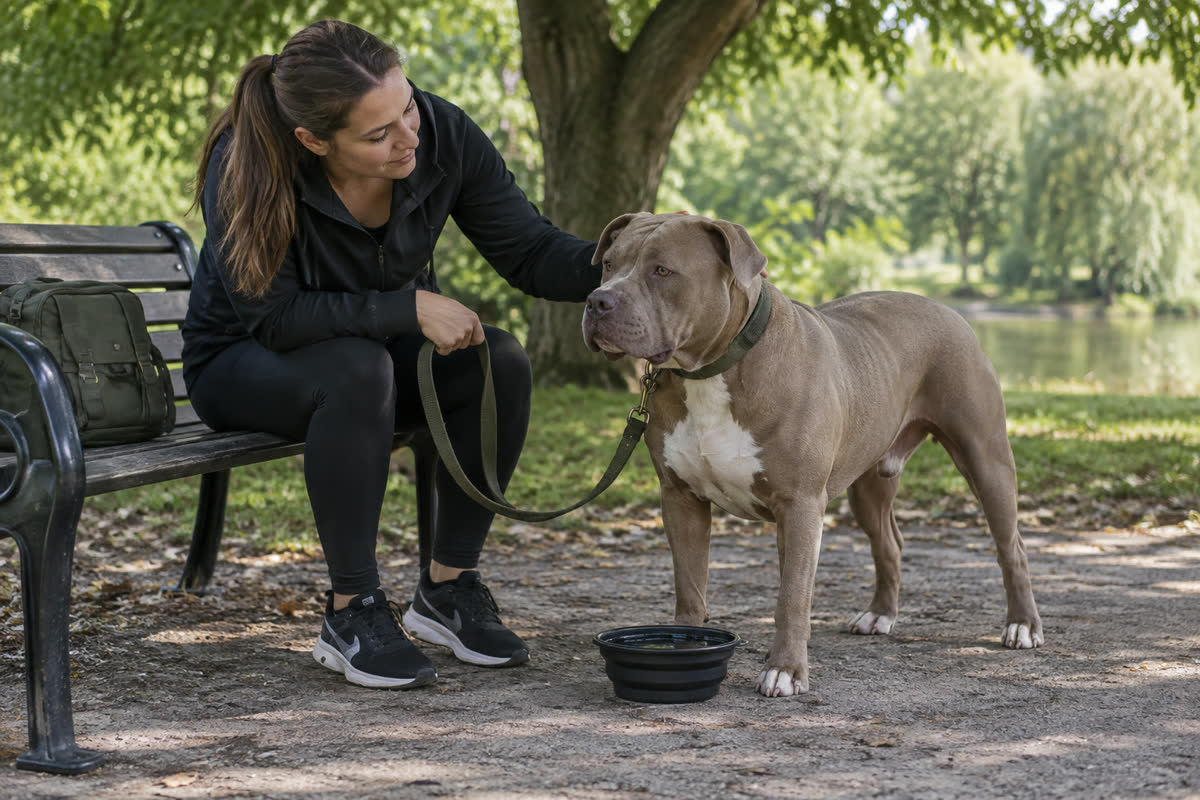
England and Wales ban XL Bully ownership under the Dangerous Dogs Act framework, with exemption available only under conditions such as neutering, muzzling and leashing in public, per the UK government’s XL Bully ban guidance, last checked September 25, 2026. Scotland enforces its own separate restriction requiring a Certificate of Exemption, the underlying legal definition starts at the 20-inch (male) / 19-inch (female) mark described above, and because these rules are still changing and vary by country, check the official source for where you live before you buy, breed, or travel with one.
Frequently Asked Questions
Are XL Bullies good for first-time owners?
Not usually a good first dog. The combination of size, strength, and the need for consistent early training and socialization means an XL Bully rewards an owner who already has some experience managing a large, powerful breed — someone without that background will find the learning curve steeper than with a smaller dog.
Conclusion
The XL Bully is the same American Bully underneath — same temperament standard, same disqualifications, same breed history — just built taller than any other recognized class. Before you commit to one, measure the parents or the puppy at the withers rather than trusting a seller’s label. Ask for the specific registry class plus hip, elbow, and cardiac screening on both parents, and check your local law if you live anywhere the breed has been restricted. Get those three things confirmed and you’ll know exactly what you’re bringing home.